
In the mid-19th century, western Ireland was gripped by one of the darkest chapters in its history. The Irish Potato Famine (1846–1851) devastated entire communities. Crops failed year after year, hunger became widespread, and hope was in short supply. Nearly a million people died, millions more emigrated, and in some regions the population fell by almost 30 percent.

It was in this bleak context that John Caldwell Bloomfield, owner of Castle Caldwell in County Fermanagh, was trying to restore his estate and bring some form of stability to the land and the people who depended on it. While travelling through the surrounding villages, he noticed something curious. The small cottages of his tenant farmers had an unusually bright white finish on their exteriors.
When he asked why, the answer was simple but unexpected: there was a deposit of exceptionally fine clay on his land.
To many, this would have been nothing more than an interesting footnote at best. But Bloomfield saw something more. He recognised not only a resource but also a possibility.
In 1857, instead of waiting for circumstances to improve, he acted. Bloomfield established a pottery factory in the village of Belleek, partly to generate revenue, but also to provide employment and dignity to people who desperately needed both. Partnering with ceramic expert Robert Williams Armstrong and financier David McBirney, he experimented with the local clay, feldspar, and kaolin. The result was a refined Parian porcelain: translucent, delicate, and marble-like in appearance.
What emerged from a time of despair was Belleek Pottery, a brand that would go on to become world-renowned. Its iridescent glaze, intricate Irish designs, and remarkable strength made it a luxury ceramic rivalling historic porcelain traditions. More importantly, Bloomfield didn’t just create a product – he created a sub-industry, an ecosystem: an opportunity that others could build upon.

A multimillion-dollar global business was born not from abundance but from attentiveness and action.
Opportunities Rarely Look Like Opportunities at First
The Belleek story illustrates a powerful truth: opportunities often appear disguised as problems, curiosities, or constraints. What differentiates businesses that grow from those that stagnate is not access to better conditions, but the ability to see differently.
This pattern repeats itself across business history.
Netflix, Blockbuster, and the Cost of Dismissing the Unfamiliar
At the turn of the millennium, Blockbuster was a household name. With thousands of physical rental stores across the world, it dominated home entertainment. Netflix, by contrast, was a small and struggling DVD-by-mail company trying to find its footing.
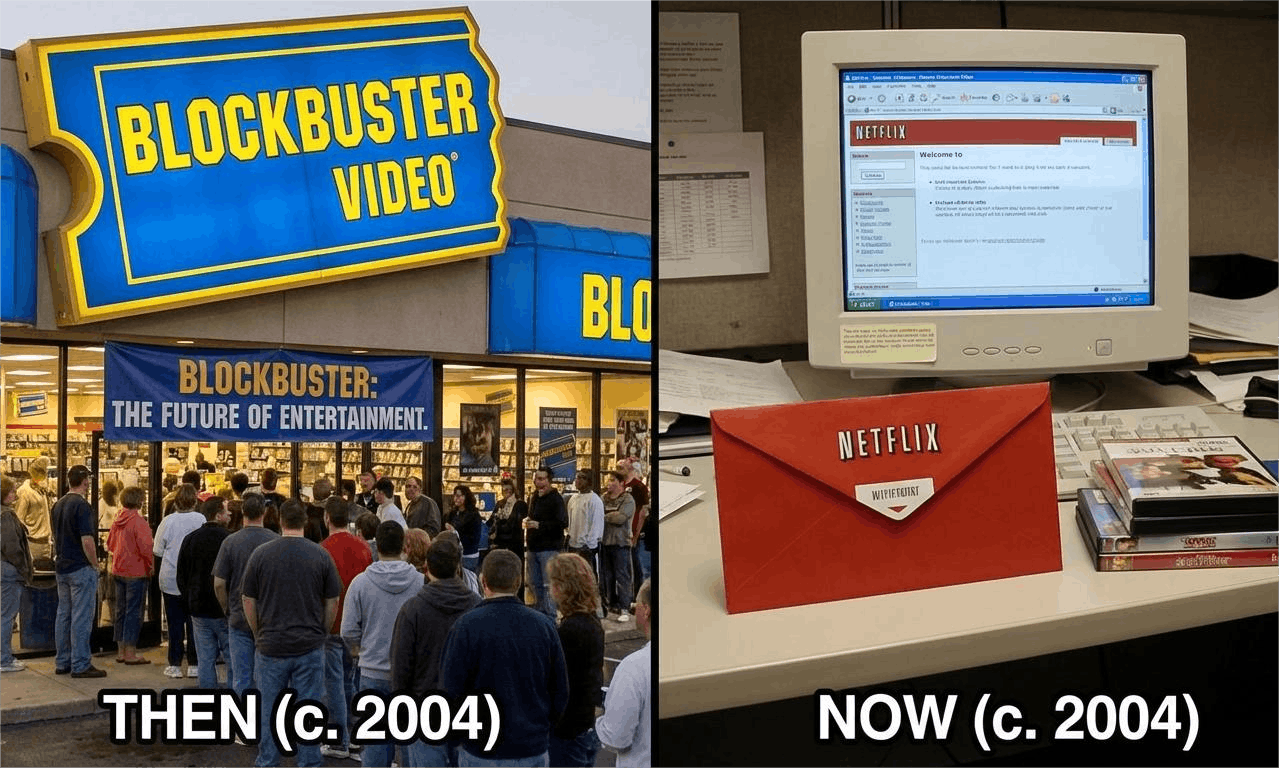
In 2000, Netflix’s founders approached Blockbuster with an offer to sell their entire business for $50 million. Blockbuster’s leadership reportedly laughed them out of the room. To them, Netflix was a niche experiment, no match for the scale and success of physical retail.
What Blockbuster failed to see was not just a competitor, but a shift in behaviour. Customers were beginning to value convenience over location. Choice over inventory limits. Flexibility over late fees.
Netflix kept iterating – first refining its mail-based model, then investing heavily in streaming technology. Blockbuster, on the other hand, remained tied to its existing success. It was slow to adapt, burdened by legacy systems and short-term thinking.
The result is well known. Netflix became a global entertainment powerhouse that reshaped how the world consumes content. The recent announcement that it reached an agreement to buy Warner Bros. Discovery (WBD)'s studio and streaming assets for about $82.7 billion is another testament to how far Netflix has come. On the other hand, Blockbuster, once synonymous with movie nights, filed for bankruptcy in 2010. The opportunity didn’t disappear – it simply moved to someone willing to act on it.

Xerox PARC and the Opportunity That Walked Out the Door
A different but equally telling story comes from Xerox.
In the 1970s, Xerox established the Palo Alto Research Center (PARC), one of the most advanced innovation labs of its time. Inside PARC, researchers developed technologies that would later define modern computing: the graphical user interface (GUI), the computer mouse, Ethernet networking, and object-oriented programming.
Yet Xerox’s leadership was focused on what it already did best: photocopiers. These new inventions didn’t fit neatly into their existing business model. As a result, they failed to recognise their commercial potential.
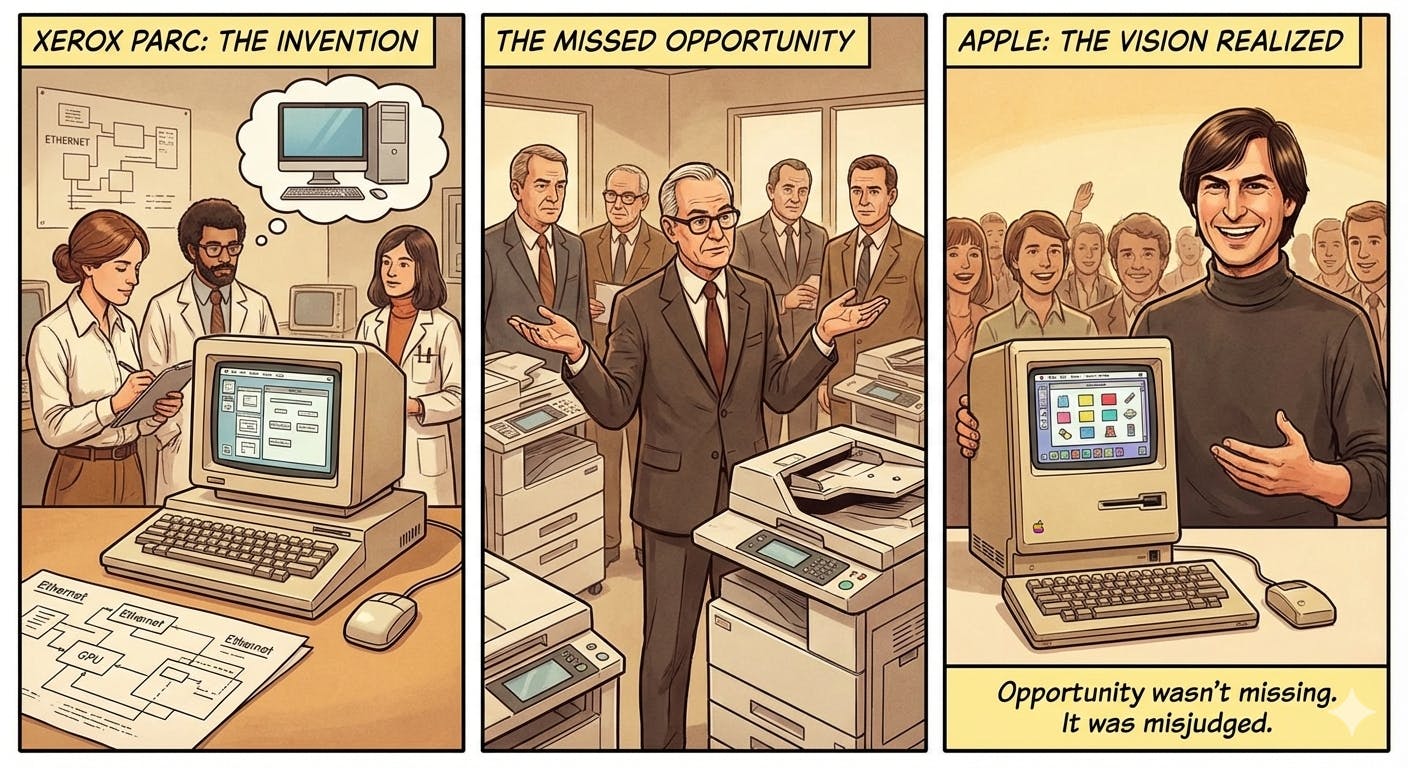
When Steve Jobs visited PARC in 1979, he immediately grasped what Xerox could not. Apple did not invent the mouse or the GUI, but it understood their future value. Apple refined these ideas, built consumer-friendly products around them, and brought them to the mass market through the Macintosh.
Xerox had the technology. Apple had the vision.
Once again, the opportunity wasn’t missing. It was misjudged.
Where Opportunities Actually Come From
Stories like Belleek, Netflix, and Apple show us that opportunities emerge from many places:
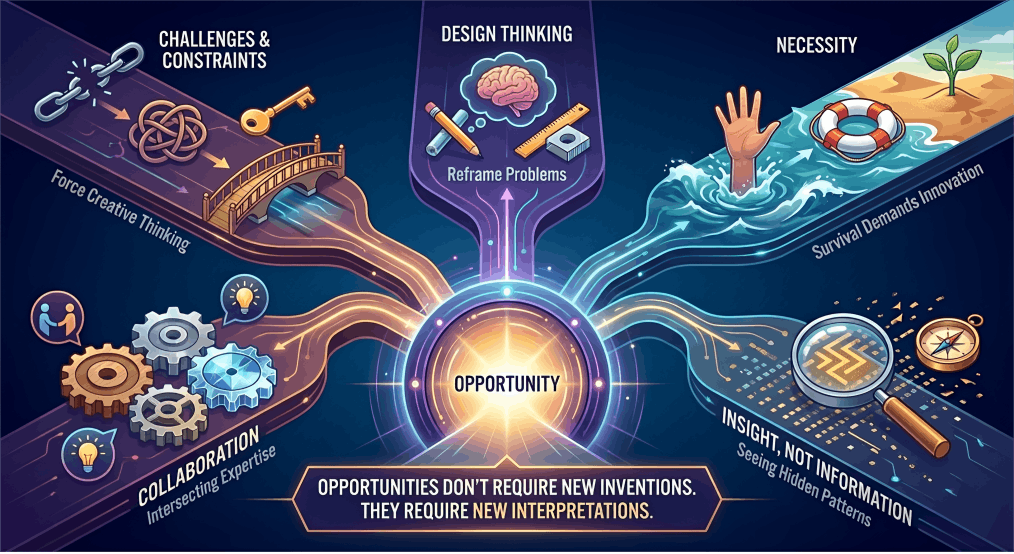
1. From challenges and constraints, which force creative thinking
2. From collaboration, where different expertise and perspectives intersect
3. From design thinking, which reframes problems instead of accepting them as fixed
4. From necessity, when survival demands innovation
5. From insight, not information – seeing patterns others overlook
Often, opportunities don’t require new inventions. They require new interpretations.
Why Businesses Miss Opportunities
If opportunities are everywhere, why do so many organisations fail to act on them?
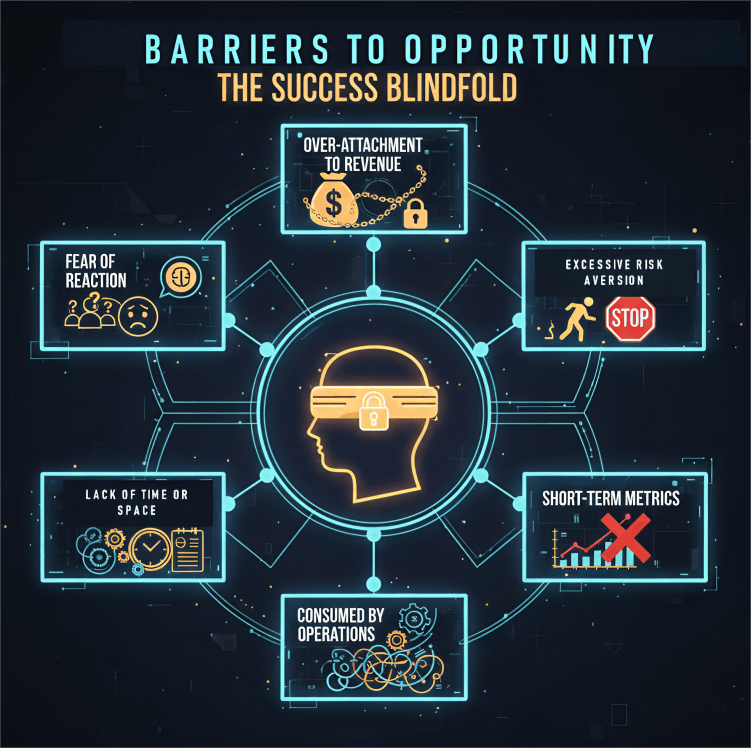
Common barriers include:
1. Fear of how investors, boards, or peers will react
2. Over-attachment to existing revenue streams
3. Excessive risk aversion
4. Being consumed by day-to-day operations
5. A lack of time or space to think strategically
6. Short-term metrics overshadowing long-term shifts
In many cases, success itself becomes the blindfold.
Developing the Discipline to See What Others Miss
Opportunity recognition isn’t accidental: it’s a discipline. It is an ability or skill that can be developed.
Some practical ways businesses can sharpen this ability include:
1. Stepping back and revisiting decisions after time has passed
2. Asking better, more uncomfortable questions
3. Analysing situations from multiple angles – customer, market, future-state
4. Taking a bird’s-eye view instead of staying stuck in execution mode
5. Understanding evolving consumer behaviour, not just current demand
6. Staying alert to cultural, technological, and lifestyle shifts
The goal is not to chase every idea, but to avoid dismissing the ones that matter. It is also about cultivating the habit of curiosity because opportunity favours the observant.
From Waiting for Opportunities to Creating Them
The most transformative organisations don’t wait for perfect conditions. They create momentum where none seems possible.
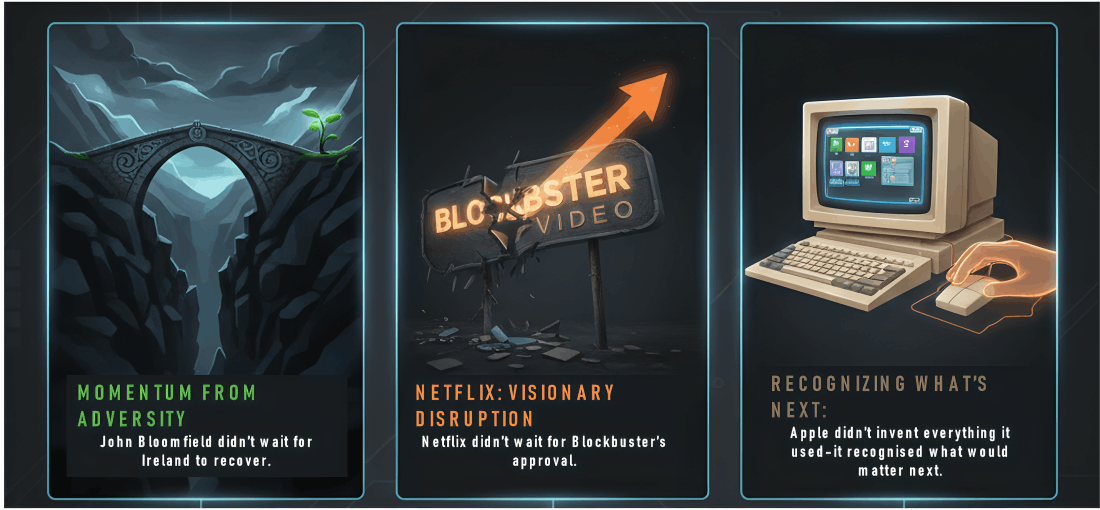
John Bloomfield didn’t wait for Ireland to recover.
Netflix didn’t wait for Blockbuster’s approval.
Apple didn’t invent everything it used – it recognised what would matter next.
Opportunity creation is an intentional act.
Looking Ahead with a Different Lens
As another year draws to a close, it’s natural to reflect on opportunities we may have missed. But progress doesn’t come from regret – it comes from recalibrating how we look forward.
What if we explored unfamiliar ideas instead of dismissing them?
What if we trained ourselves to see challenges as signals rather than setbacks?
What if we approached uncertainty with curiosity instead of caution?
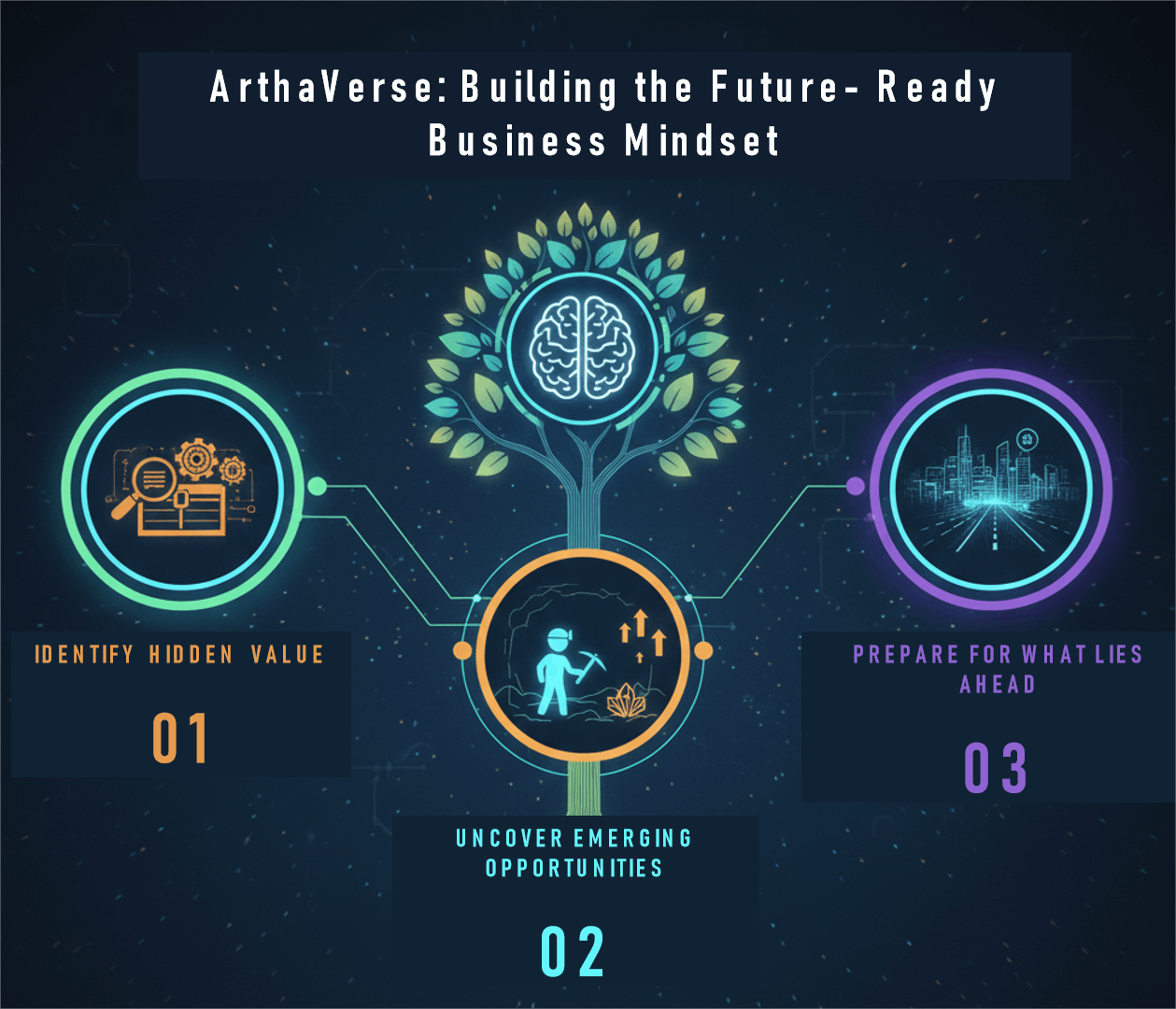
At ArthaVerse, this is the mindset we help businesses build. We work with organisations to identify hidden value, uncover emerging opportunities, and prepare for what lies ahead – whether within existing models or beyond them.
Because in business, growth doesn’t belong to those who wait for an opportunity.
It belongs to those who learn how to see it or even create it.

