
79% Want to Lead: Only 1% Do!
This Women’s Day, Let’s Stop Celebrating and Start Fixing
Picture a boardroom. Ten people seated around the table. Now ask yourself: how many of them are women? If you guessed three, you’re being optimistic. The answer, according to a sweeping new report by KPMG and AIMA, is two. Two out of ten. India’s boardrooms now look more modern but gender diversity remains strikingly low.
You might still say ‘two out of ten is progress’: hold on! Because behind that number lies a story that doesn’t get told over roses and panel discussions on International Women’s Day.
The Numbers Don’t Lie — But They Don’t Tell the Whole Truth Either
Let’s start with what looks like good news. Among organizations already tracking female representation, the share of companies with over 30% women in leadership has risen from 35% in 2024 to 44% in 2026. That’s meaningful movement.
But here’s what that headline obscures:
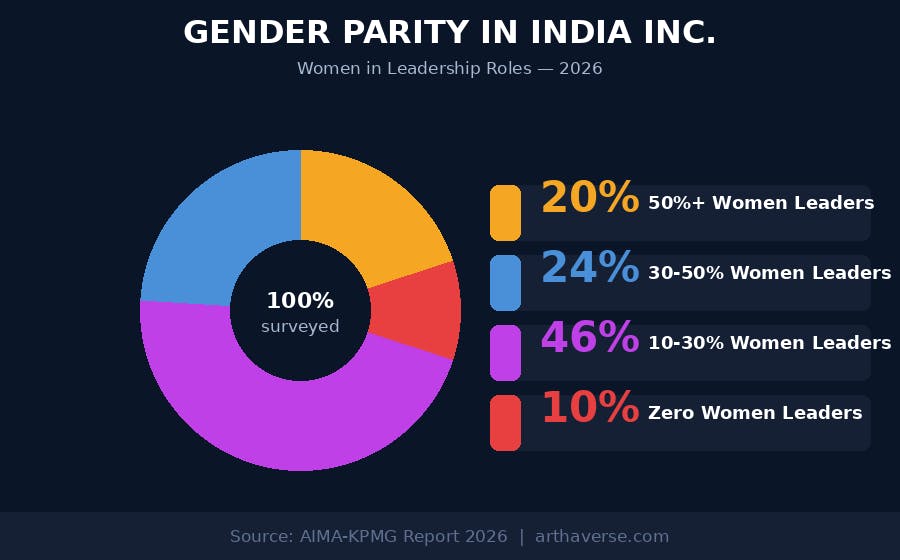
10% of Indian companies have zero women in leadership. Not one.
46% have less than 30% women in leadership roles.
Only 20% are anywhere close to gender balance.
So yes, some companies are doing better. But most cluster at the bottom. And a troubling 30% of Indian companies saw absolutely no improvement in women’s leadership numbers over the past five years. Progress is not evenly distributed. Progress has not stopped but it has slowed down.
She Didn’t Leave Because She Gave Up
Here’s the myth that gets buried under Women’s Day gift hampers every single year: women lack ambition. They don’t want the top jobs. They chose family over career.
The data says otherwise — and loudly —
79% of working women in India want leadership roles.
52% actively want C-suite positions.
These are not women who stepped off the ladder. These are women who were pushed off it — or never given a rung to stand on.
The critical phrase here is not ‘glass ceiling.’ It’s broken rung — that very first path from entry-level to manager. If women don’t get that first promotion at equal rates, the rest of the ladder is irrelevant. They never reach a ceiling to break because the climb was interrupted much, much earlier.
And when does this break happen most? Mid-career. That messy, pressured stretch of 5 to 15 years in, where life gets complicated and organizations get complacent. A full 65% of respondents identified middle and senior management as the stage where women are most likely to exit — not the beginning, not the end, but right in the middle of the race.
It’s Not Personal. It’s Structural.
Why are women leaving at mid-career? The report lays it out:
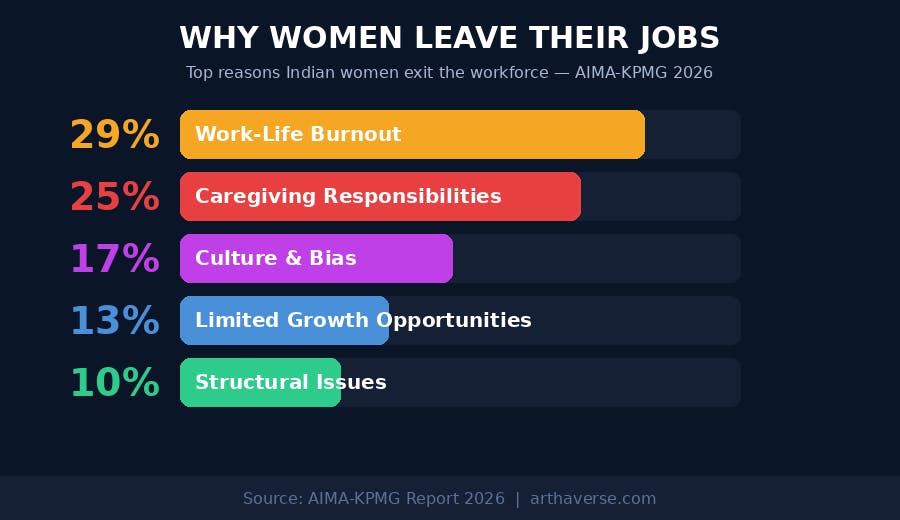
Notice anything? Burnout. Caregiving. Bias. Limited growth. Structural issues. How many of these are personal failings? Most of these are organizational failures.
The discrimination isn’t always the kind that makes headlines. It’s quieter. 39% of women have experienced or witnessed gender discrimination at work — being overlooked in meetings, bypassed for high-visibility projects, judged on past performance while male peers are evaluated on potential. And only 28% of employees believe promotions in their organizations are fair. That means 7 out of 10 people already know the system is rigged. They just can’t say it out loud.
What Actually Needs to Change
So, is this report just a survey? This Women’s Day, we say it is a mirror. It shows a country where women are ambitious and ready to grow but the companies they work for are not ready for them. The report doesn’t just hold up a mirror — it points to a door. Here’s what organizations need to think through first and then walk through:
· Fix the broken rung first. Track first-promotion rates by gender. Make it a metric, not an aspiration.
· Build a mid-career bridge. Mentorship, sponsorship, and flexible structures targeted at the 5- to 15-year band.
· Open the training room. 50% of women had not participated in any leadership development in the past year — a pipeline problem companies are creating themselves.
· Measure what matters. Count women in P&L seats, boardrooms, and decision-making roles — not just on the org chart.
The Neo ArthaVerse Approach
At ArthaVerse, we work with men and women leaders just the same: without any bias because we recognize potential when we see it, irrespective of gender. Leadership, in our experience, has nothing to do with gender. We’ve seen it in the women who run businesses, sit on boards, and make calls that move markets. If we hadn’t seen it clear enough earlier, this study reminded us that the gap in India’s boardrooms is not a talent gap. It’s a systems gap. And that costs everyone.
This Women’s Day, Less Noise. More Action.
International Women’s Day will arrive with its LinkedIn posts, panel discussions, and promises. And most of it, statistically speaking, will change nothing for the 79% of women who want to lead but are still waiting for someone to hold the door open.
The ambition is already there. The will is already there. What’s missing is the organizational commitment to build systems that don’t force women to choose between their careers and their lives — or worse, make that choice for them.

This Women’s Day, the most powerful thing a company can do is not put up a banner. It’s to look at its own promotion data, its own leadership pipeline, its own meeting room dynamics — and ask honestly: are we part of the problem, or are we actually doing something about it?

