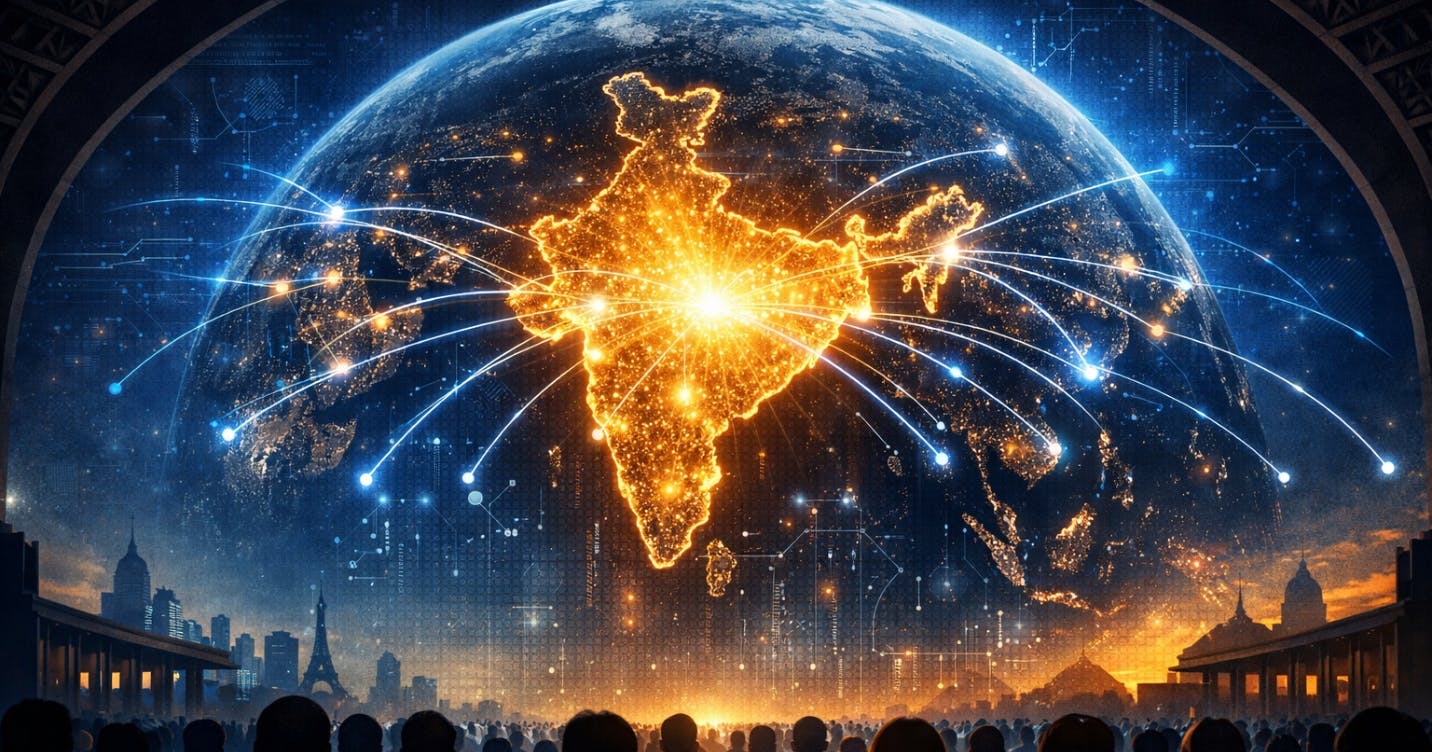
From Safety to Impact: How India Is Rewriting the Rules of the AI Era
New Delhi, February 2026 — When the world’s first major AI summit convened at Bletchley Park in the United Kingdom in 2023, the conversation was dominated by one word: safety. Governments and technologists gathered to grapple with existential risks, guardrails, and the dangers of systems spiraling beyond human control. The Seoul AI Summit in 2024 continued in that vein, and Paris in 2025 added a layer of geopolitical competition to the mix. Each summit was important, but each was also, in many ways, a conversation among a narrow club of technologically advanced nations.
India just changed that.
The AI Impact Summit, which concluded in New Delhi on 21 February 2026, was the fourth in this global series — and arguably its most ambitious iteration yet. Hosted at the Bharat Mandapam, the summit was the first of its kind to be held in the Global South, and it was built to a scale that simply dwarfs its predecessors. Over 100 countries and 30 international organizations participated. More than 20 heads of state attended, including French President Emmanuel Macron and Brazilian President Luiz Inácio Lula da Silva. Over 50 ministers made the trip to New Delhi. Across five days, the event drew a staggering 250,000 registered attendees. The message was hard to miss: AI is no longer a conversation between Washington and a few European capitals.
Read more: When AI Crossed the Line — And Why India Just Drew One
From Safety to Opportunity: India Rewrites the Agenda
The shift India engineered was not merely geographical — it was philosophical. Where earlier summits focused primarily on the risks of AI, India arrived with a deliberate intention to broaden the scope. Prime Minister Narendra Modi and his administration made clear that India’s interest was not just in managing AI’s dangers, but in harnessing its potential — for economic growth, for social inclusion, and for environmental sustainability.
India articulated this vision through what it called three core “sutras,” or guiding principles, for the summit. The first is People — keeping AI human-centric, inclusive, and accessible to populations who have historically been left behind by technological waves. The second is Planet — ensuring that AI development is environmentally responsible, energy-efficient, and sustainable in its infrastructure demands. The third is Progress — fostering innovation that is fair and equitable, and that benefits more than just a handful of dominant companies or countries.
This framing matters. It signals that India does not want to merely play by the rules of the AI era — it wants to help write them.
The Numbers That Tell the Story
For the global technology industry, India’s case for centrality in the AI conversation is backed by hard data. OpenAI CEO Sam Altman, who attended the summit, made a striking disclosure: ChatGPT now has over 100 million weekly active users from India alone — making India the second-largest market for the platform globally, after the United States. Indians also account for the largest share of students using ChatGPT. These are not vanity statistics. They represent a consumer base of unprecedented scale that every major AI company is now racing to capture, retain, and monetize.
That commercial reality was on full display throughout the summit. All the biggest names in the global AI race — from OpenAI’s ChatGPT to Google’s Gemini — were present. And they came not just to attend, but to commit. Several major AI companies announced India-specific pricing tiers or free access to their platforms, signaling that India’s user base is simply too significant to approach with a one-size-fits-all global strategy.
Among the most consequential announcements: Anthropic, maker of the Claude AI system and one of OpenAI’s most formidable competitors, confirmed it will open its first office in India — in Bengaluru, widely regarded as India’s Silicon Valley. This is a landmark moment. It signals that the second generation of frontier AI companies is choosing India not just as a market to sell into, but as a place to build from.
Beyond software, the summit also drew major commitments in AI infrastructure. Blackstone announced it has acquired a majority stake in Neysa, an Indian AI infrastructure startup, as part of a $600 million equity fundraise. Meanwhile, the Indian government itself moved ahead of the summit with a significant policy action: it cleared a state-backed venture capital fund worth $1.1 billion, designed to channel private capital into AI and advanced manufacturing startups across the country.
Diplomacy at the Margins — and at the Top
Some of the summit’s most significant moments happened not in plenary sessions but in bilateral meetings on the sidelines. Prime Minister Modi met separately with Google and Alphabet CEO Sundar Pichai to discuss how Google can deepen its collaboration with India’s pool of AI talent and students. Modi described the meeting as a “delight,” noting the conversation covered India’s rapid progress in AI and the potential for expanded cooperation. It was a reminder that at events of this scale, the corridor conversations often carry as much weight as the stage appearances.
The summit was attended by a full constellation of tech leadership: Sundar Pichai of Google, Sam Altman of OpenAI, Dario Amodei of Anthropic, Demis Hassabis of Google DeepMind, Mukesh Ambani of Reliance Industries, and Microsoft President Brad Smith, among others. The gathering of this caliber of decision-makers in one room — alongside heads of state — underscores how AI governance has become inseparable from geopolitics, trade, and national strategy.
The ArthaVerse Lens: Reading the Direction of Travel

At ArthaVerse, this summit is something we have been following because we track economic and technological developments shaping the business landscape. We are not only committed to staying genuinely attentive to the ecosystem around us but to also translate that attentiveness into clear-eyed assessments of where the economy and business landscape are heading.
The AI Impact Summit is not background noise. It is signal. And here is what we read in it.
First, India is no longer a passive participant in the global AI story. The decision to host this summit, to frame it around the three sutras of People, Planet, and Progress, and to draw over 110 countries to participate — all of this reflects a deliberate assertion of agency. For businesses operating in or with India, this translates into a more active and opinionated regulatory environment, one that will increasingly seek to define the terms on which AI operates in the country.
Second, the commercial stakes are enormous and accelerating. When the CEO of the world’s most prominent AI company tells you that his platform has 100 million weekly active users from a single country, and that country is also attracting a $1.1 billion government fund, a $600 million infrastructure deal, and Anthropic’s first international office — the direction of travel is clear. India is becoming a primary theater for AI investment, competition, and deployment. Businesses that understand this early will be better positioned to navigate what comes next.
Third, and perhaps most importantly: the gap between AI hype and AI impact is closing faster than most organizations are prepared for. The three broad areas India has identified — infrastructure, users, and talent — are not abstract priorities. They are shaping the conditions under which AI products will be built, regulated, and adopted at scale. For businesses assessing AI strategy, these dimensions are as important as raw capability benchmarks.
At ArthaVerse, we believe that informed anticipation is one of the most valuable capacities any organization can develop. The AI Impact Summit is a moment worth studying — not just for what it announced, but for what it reveals about where the world is going. We are watching, assessing, and as always, committed to helping you navigate the road ahead with clarity and confidence.