
How SMEs Can Raise Growth Capital Without Losing Control: Smart Funding Strategies for Sustainable SME Growth
India’s Evolving SME Funding Ecosystem
India’s SME funding ecosystem has evolved significantly, with SME IPO platforms, NBFC-led credit expansion, and increasing private equity participation creating multiple pathways for raising growth capital without an immediate loss of control. For most SMEs, however, the challenge is not merely accessing capital but securing the right kind of capital without compromising long-term control, vision, and value. In today’s dynamic funding environment, promoters must move beyond the simplistic binary of debt versus equity and adopt a more strategic, layered approach to capital structuring. This article explores how SMEs can fund growth intelligently while preserving ownership and strategic autonomy.

Common Fundraising Mistakes SMEs Must Avoid
One of the most critical issues is that many SMEs undermine their own future during the fundraising process. A common mistake is raising the wrong type of capital — for instance, relying on short-term working capital loans to fund long-term expansion, which creates liquidity stress and exposes the business to refinancing risks. Premature equity dilution is another frequent misstep, where founders give away substantial ownership at an early stage when valuations are still low, resulting in a long-term loss of control. Similarly, over-leveraging without clear visibility of cash flows can become dangerous; while debt may appear attractive, it quickly turns into a burden if repayment capacity is uncertain. Many SMEs also fail to adopt a structured capital strategy, raising funds opportunistically rather than strategically, without understanding how each layer of funding impacts cost, control, and returns. These challenges are often compounded by weak governance and inadequate financial reporting, which lead investors to price in higher risk, thereby increasing dilution or the cost of capital. The result is growth that often comes at the expense of control.
Understanding Working Capital, Growth Capital, and Strategic Capital

A fundamental gap in many SMEs is the lack of clarity in distinguishing between distinct types of capital needs. Working capital is required for day-to-day operations such as inventory management, receivables, and payroll, and is typically funded through short-term debt instruments like cash credit or invoice financing. Growth capital, on the other hand, supports expansion initiatives such as entering new markets, increasing production capacity, or launching new products, and is best suited to structured debt, private credit, or hybrid instruments. Strategic capital is used for acquisitions, partnerships, or business transformation and usually involves equity or strategic investors who bring not only funds but also expertise and networks. The real issue, therefore, is not the act of raising capital, but the misalignment between the type of capital and its intended purpose.
Debt Financing vs Equity Financing: Balancing Cost, Control, and Flexibility
Choosing between debt financing, equity financing, and hybrid funding structures involves balancing cost, control, and flexibility. Debt financing preserves ownership and offers predictable repayment obligations, making it suitable for businesses with stable cash flows, although excessive reliance increases financial risk. Equity financing eliminates repayment pressure and can bring in valuable strategic partners, but it comes at the cost of ownership dilution and potential loss of control.
Why Mezzanine Financing and Hybrid Funding Are Growing in Popularity
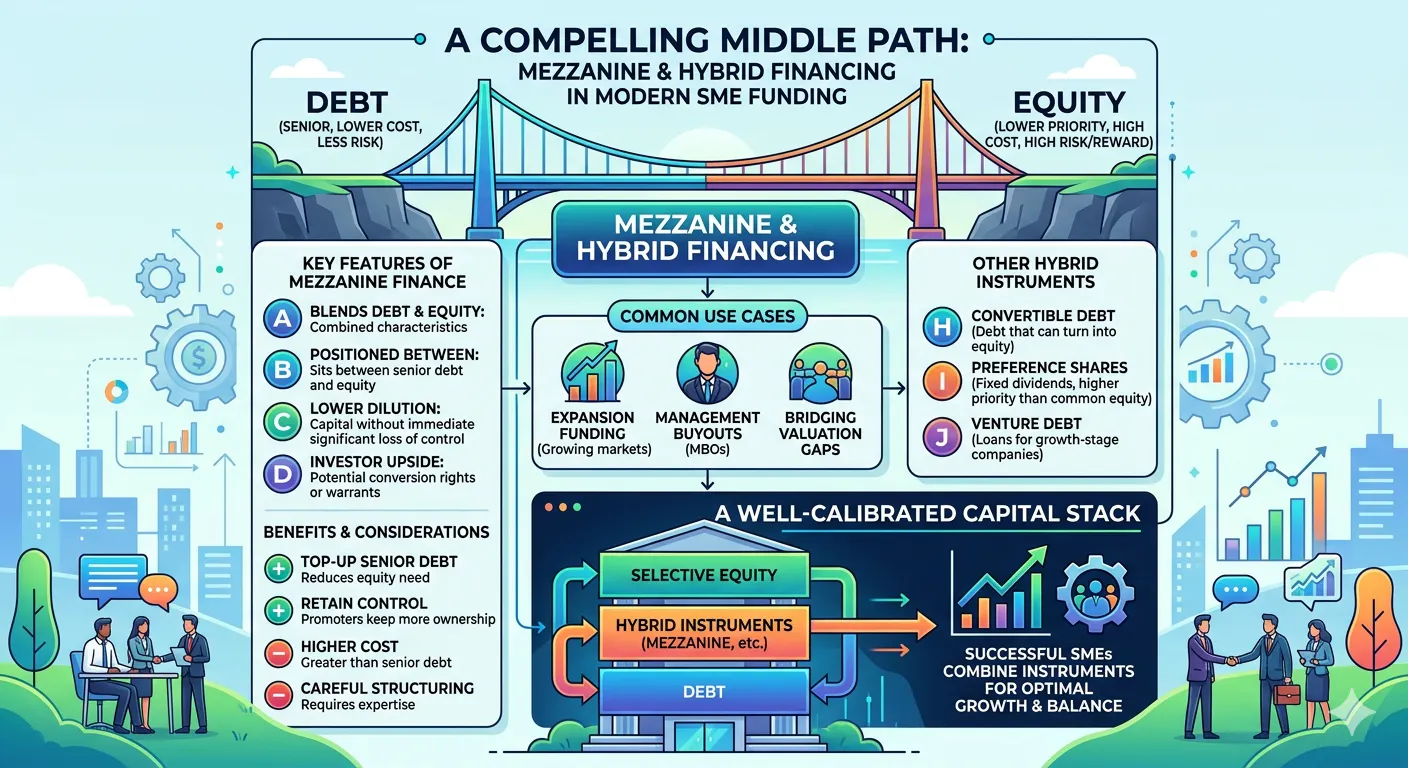
In this context, mezzanine financing and hybrid financing emerge as a compelling middle path in modern SME funding. Mezzanine finance, positioned between debt and equity, combines features of both and enables businesses to raise capital without immediate dilution while offering investors potential upside through conversion rights or warrants. It is particularly useful for expansion funding, management buyouts, and bridging valuation gaps. By effectively topping up senior debt, it reduces the need for equity and helps promoters retain control, though it comes at a higher cost and requires careful structuring. Alongside mezzanine financing, other hybrid instruments such as convertible debt, preference shares, and venture debt provide additional flexibility, allowing dilution to be deferred. The most successful SMEs today do not raise funds in isolation; instead, they design a well-calibrated capital stack by thoughtfully combining debt, hybrid instruments, and selective equity.
Governance and Financial Discipline: The Invisible Capital
Equally important is governance and financial discipline, which can be considered a form of “invisible capital.” Capital does not flow merely to opportunity; it flows to credibility. Investors and lenders increasingly prioritise clean financial statements, strong internal controls, transparent reporting, and disciplined compliance. SMEs with robust governance frameworks benefit from a lower cost of capital, improved access to institutional funding, and higher valuations. In fact, hybrid instruments such as mezzanine financing often require structured agreements and covenants, making governance a prerequisite rather than an option. Improving governance is therefore one of the most cost-effective ways to unlock better funding opportunities.
Negotiating Investor Rights Without Losing Business Control

Negotiating investor rights is another crucial dimension where control can be won or lost. Raising capital is not just about valuation; it is equally about structuring terms. SMEs must carefully negotiate board representation to avoid disproportionate control by minority investors and ensure that reserved matters or veto rights are limited to critical decisions rather than routine operations. Liquidation preferences ought to be balanced to prevent disproportionately benefiting investors and exit clauses should avoid imposing rigid deadlines that may not reflect actual business circumstances. In the case of hybrid instruments, conversion terms must be designed with caution to ensure that temporary business stress does not trigger unintended dilution. In practice, control is often lost not through shareholding alone, but through contractual clauses.
The Importance of Board-Level Oversight in Funding Decisions
Finally, funding decisions should never drive strategy; they require board-level oversight. An effective board plays a critical role in evaluating capital structure options, stress-testing assumptions, ensuring alignment with long-term strategy, and leveraging investor networks. Independent directors and advisors add further value by acting as negotiation buffers, helping founders avoid unfavourable terms under pressure. In mature SMEs, funding strategy becomes an integral part of boardroom discussions rather than a purely transactional exercise, ensuring that capital raising aligns with sustainable growth and long-term value creation.
Choosing the Right Funding Strategy for Long-Term SME Growth
Finally, choosing between debt, equity, and hybrid structures is a strategic trade-off between cost, control, and flexibility. Debt financing allows promoters to retain full ownership and offers predictable repayment obligations, making it suitable when cash flows are stable and visible; however, excessive reliance on debt — such as term loans or NBFC funding commonly used by Indian SMEs — can increase financial risk if not aligned with cash generation. Equity financing, on the other hand, eliminates repayment pressure and often brings strategic investors such as private equity funds or venture capital firms, as seen in several Indian SME growth stories and SME IPOs on exchanges like NSE Emerge; however, it comes at the cost of ownership dilution and potential loss of control. Increasingly, many growth-oriented businesses are adopting hybrid instruments such as mezzanine financing or convertible debentures, which combine features of both debt and equity, allowing companies to raise capital while deferring dilution and maintaining greater strategic control. The right choice depends on the company’s stage of growth, cash flow stability, and long-term vision, rather than short-term funding convenience.