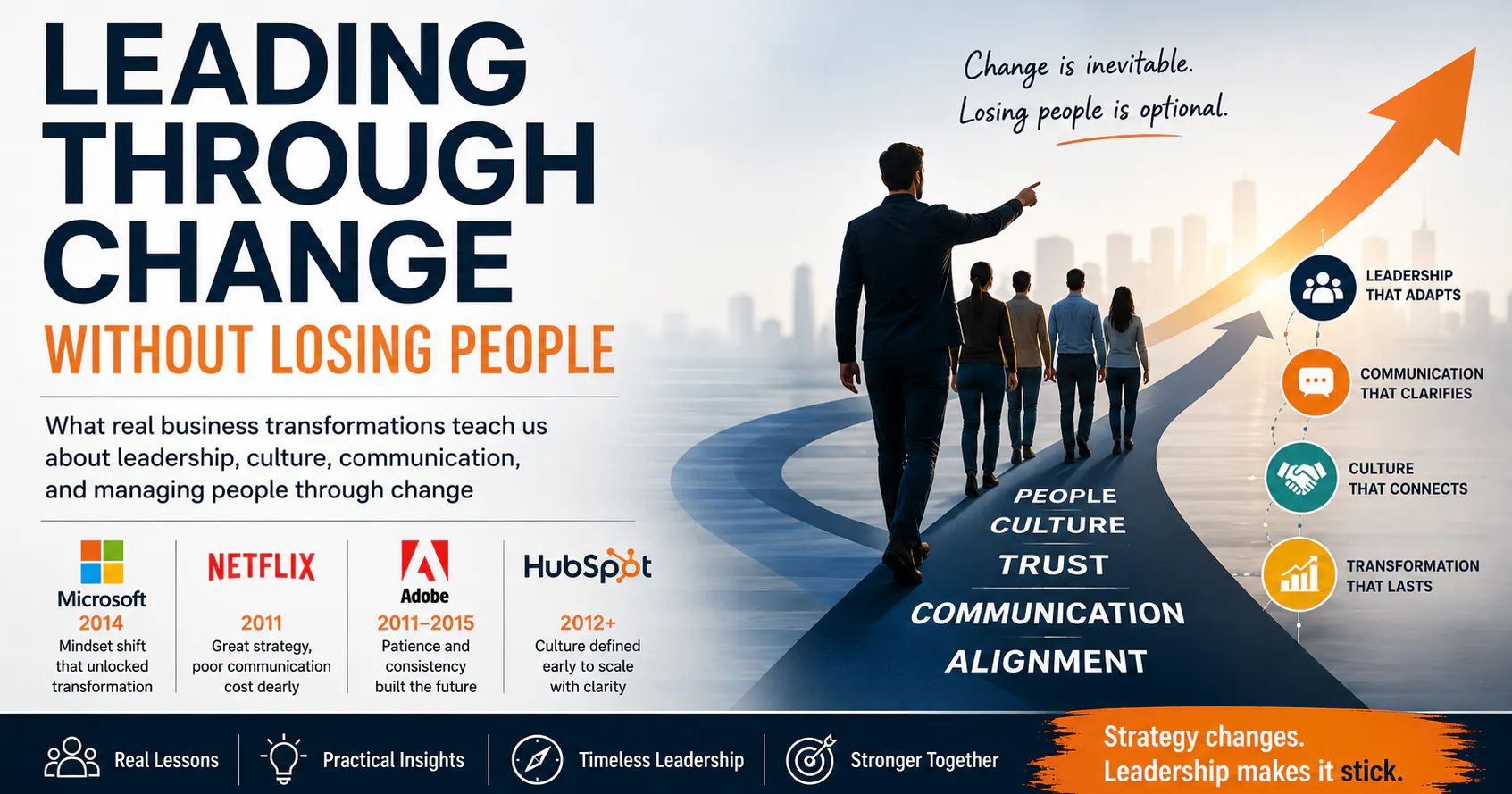
Leading Through Change Without Losing People
What real business transformations teach us about leadership, culture, communication, and managing people through change
Introduction
Over the years, I’ve seen and experienced enough leadership to notice a pattern:
Change doesn’t usually fail on paper. It struggles in people’s heads–and hearts.
And that struggle rarely shows up loudly at first.
It shows up like this:
- There is a disconnect between leadership and the team
- A strong performer becomes unusually quiet
- A dependable manager stops taking initiative
- Teams start “doing the work” but stop owning it
By the time this becomes visible, trust has already taken a hit.
So instead of theory, let’s ground this in real business transformations–with timelines–and what they quietly reveal about leadership.
2014: Microsoft Changed Its Mindset Before Its Strategy Fully Landed
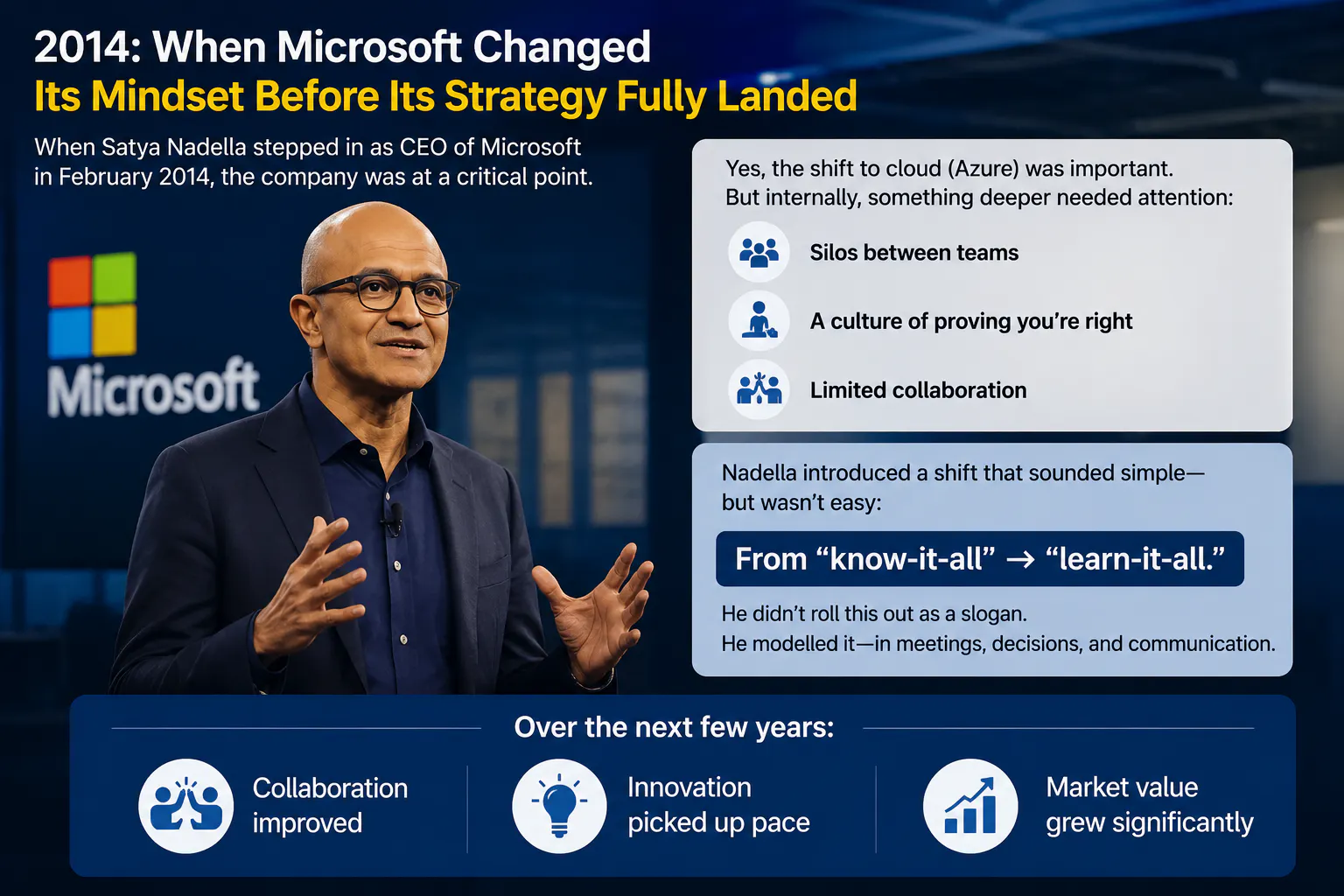
When Satya Nadella stepped in as CEO of Microsoft in February 2014, the company was at a critical point.
Yes, the shift to cloud (Azure) was important. But internally, something deeper needed attention:
Silos between team | A culture of proving you’re right | Limited collaboration
Nadella introduced a shift that sounded simple–but wasn’t easy:
From “know-it-all” → “learn-it-all.”
He didn’t roll this out as a slogan. He modelled it–in meetings, decisions, and communication.
Over the next few years:
Collaboration improved | Innovation picked up pace | Market value grew significantly
Leadership Insight
If your leadership behaviour doesn’t change, your strategy won’t stick.
2011: Netflix Got the Strategy Right–but the Communication Wrong
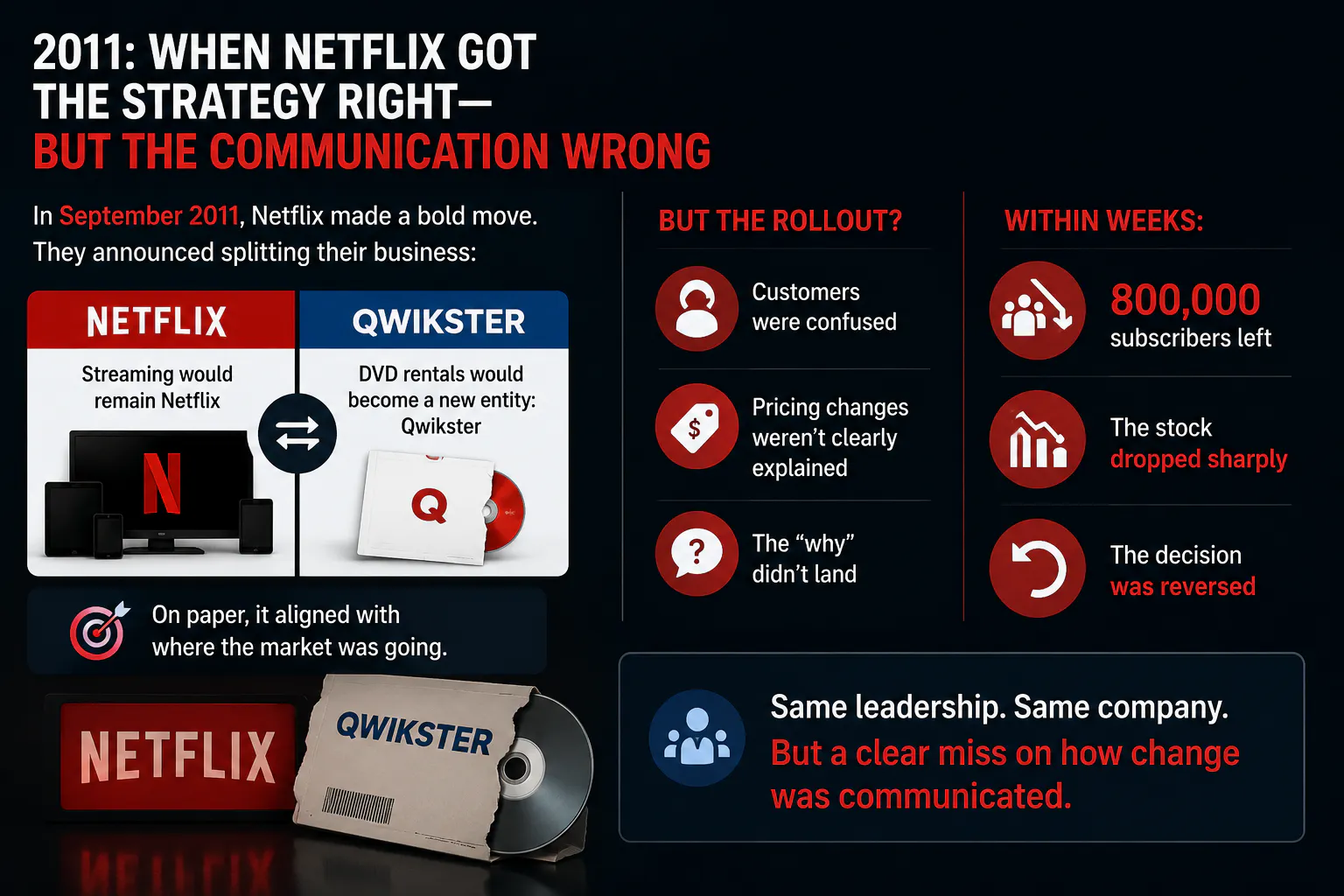
In September 2011, Netflix made a bold move.
They announced splitting their business:
Streaming would remain Netflix | DVD rentals would become a new entity: Qwikster
On paper, it aligned with where the market was going. But the rollout?
Customers were confused | Pricing changes weren’t clearly explained | The “why” didn’t land
Within weeks:
800,000 subscribers left | The stock dropped sharply | The decision was reversed
Same leadership. Same company. But a clear miss on how change was communicated.
Leadership Insight
In the absence of clarity, people don’t wait–they assume and those assumptions are rarely positive.
2011–2015: Adobe’s Transformation Tested Patience
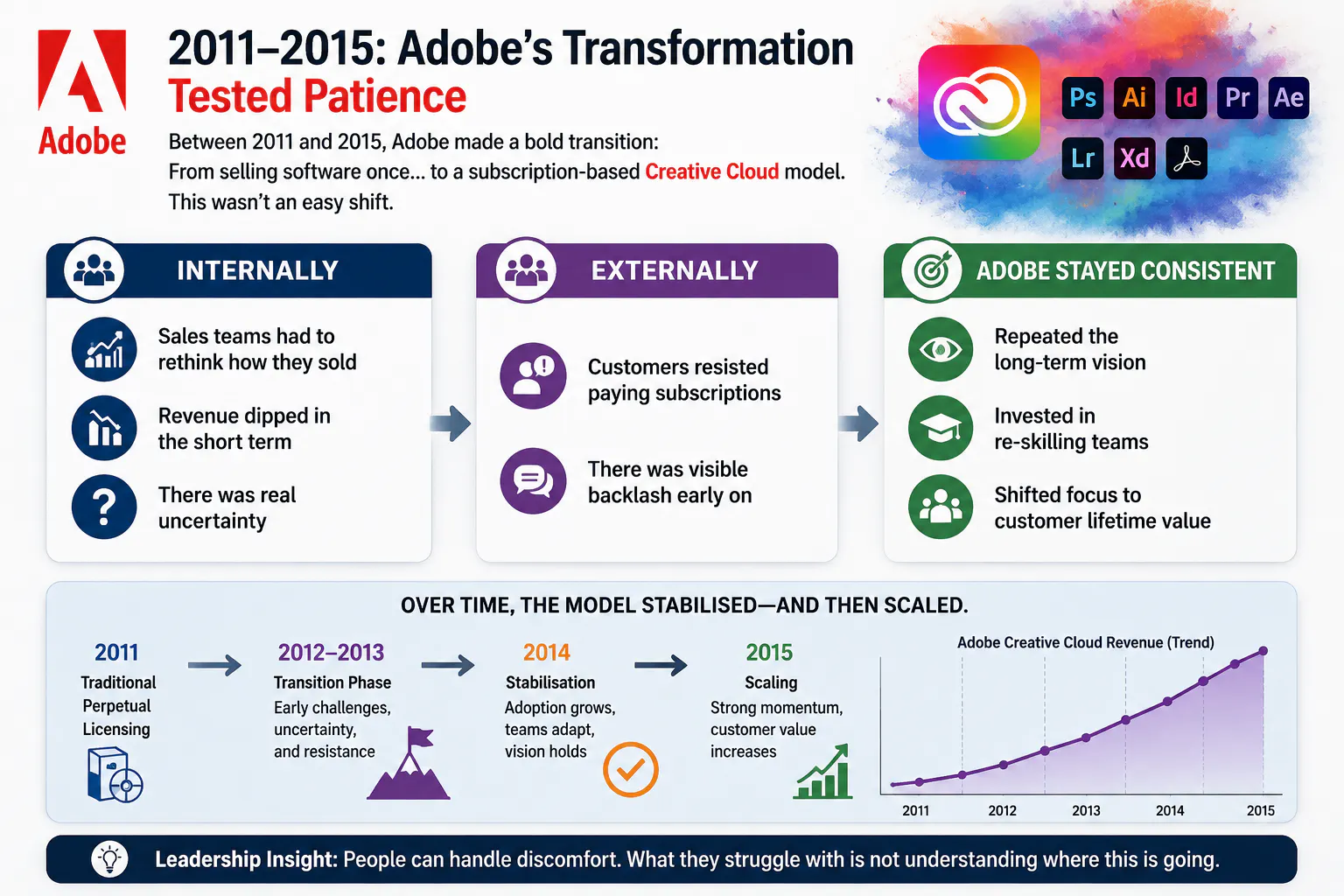
Between 2011 and 2015, Adobe made a bold transition:
From selling software once… to a subscription-based Creative Cloud model.
This wasn’t an easy shift.
Internally
Sales teams had to rethink how they sold | Revenue dipped in the short term | There was real uncertainty
Externally
Customers resisted paying subscriptions | There was visible backlash early on
But Adobe stayed consistent:
Repeated the long-term vision | Invested in re-skilling teams | Shifted focus to customer lifetime value
Over time, the model stabilised–and then scaled.
Leadership Insight
People can handle discomfort. What they struggle with is not understanding where this is going.
2012 Onwards: HubSpot Prevented Future Chaos by Defining Culture Early
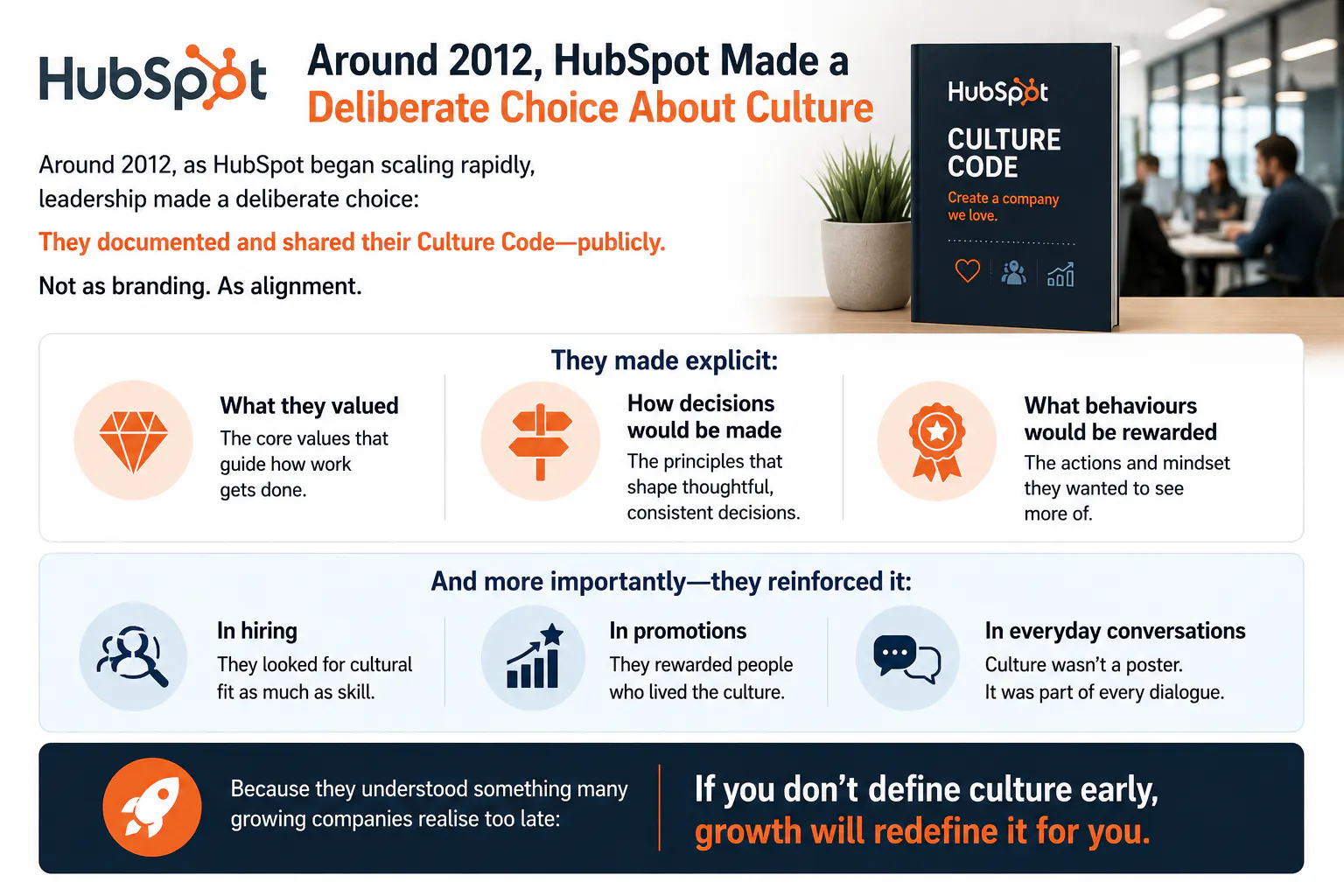
Around 2012, as HubSpot began scaling rapidly, leadership made a deliberate choice:
They documented and shared their Culture Code–publicly.
Not as branding. As alignment.
They made explicit:
What they valued | How decisions would be made | What behaviours would be rewarded
And more importantly–they reinforced it:
In hiring | In promotions | In everyday conversations
Because they understood something many growing companies realise too late:
If you don’t define culture early, growth will redefine it for you.
What This Means for Leaders Today
Whether you’re an MSME or a growth-stage business, the patterns are surprisingly similar.
1. Lead today with your future in mind
If your future business needs empowered teams… but today everything depends on you–that gap will show up during change.
2. Over-communicate clarity
Say:
- What’s changing
- What’s not
- What’s still unclear
That last one builds more trust than silence ever will.
3. Help people locate themselves in the vision
A strategy becomes real when people can answer:
“Where do I fit into this?”
4. Increase connection–not just targets
Deadlines go up → Conversations go down.
Even a 10-minute check-in can shift ownership and energy.
5. Let your team see you learning
You don’t need perfect answers.
But if you act like you have them, your team will stop thinking–and start waiting.
Final Thought
Microsoft didn’t just change strategy in 2014–they changed how leaders showed up.
Netflix didn’t fail in 2011–they misjudged how change would be received.
Adobe didn’t rush transformation–they stayed consistent through discomfort.
HubSpot didn’t leave culture to chance–they made it explicit early.
Different companies. Different contexts.
Same underlying truth:
You don’t lose people because of change. You lose them because of how the change is experienced.
If you’re navigating change right now:
What’s taking more energy–figuring out the strategy, or bringing people along with it?
About the Author
Timothy is a Life and Executive Coach with 25+ years in behavioural transformation. A certified Brain-Based Coach and Honorary Doctorate holder, he has led 2,000+ experiential interventions, specializing in trust, resilience, and lasting change across diverse sectors.

