
Sixty Days of Silence: How a Component Maker Broke Free from the Cash Flow Trap
Sector: MSME & Manufacturing
Challenge: Working capital squeeze between long receivables and short payables
Solution: Sales Bill Discounting
Key Win: Read the case study to find out how working capital was unlocked and the resulting benefits
The Order Book Was Healthy. The Bank Account Was Not.
On paper, the company was doing everything right.
A mid-sized component manufacturer supplying to Original Equipment Manufacturers (OEMs) had a full order book, a reliable production line, and — importantly — a strong roster of repeat customers. These were large, creditworthy buyers. The kind of customers any MSME would be proud to serve.
There was just one problem: those customers paid on 60- to 90-day credit terms.
That is the standard in the OEM world. The manufacturer knew it, accepted it, and could not change it — not without risking losing those accounts to a competitor willing to play by the same rules.
“An order delivered is not the same as revenue received — not when payment is 90 days away.”
Meanwhile, on the other side of the business, the manufacturer’s own suppliers were not so patient. Most offered only 30-day payment windows. Some asked for advance payments altogether. The manufacturer was caught in a vice: long receivables on one end, short payables on the other.
They were not alone. Industry data across MSME and manufacturing sectors shows that 63% of suppliers report delayed payments as a direct threat to their ability to deliver. This is not just a cash flow inconvenience. It is a business continuity risk — and, left unaddressed, it becomes a growth ceiling.

For this manufacturer, the pressure was mounting. Statutory dues needed to be met. Loan EMIs were due. Purchase orders were pending fulfilment. And the money owed to them — real, earned revenue — was sitting in limbo on their customers’ payables ledgers, untouchable for weeks.
The question was not whether there was a problem. The question was whether there was a smarter way out of it than taking on expensive, collateral-heavy debt. The CFO had been asking the same question in a different form: could they extend payment terms by another 30 days with their own suppliers, just to buy breathing room?
The Solution: Looking Closer at the Receivables
When the manufacturer connected with the financial advisory team at ArthaVerse, the first step was not to reach for a standard product. It was to understand the actual structure of the business — specifically, who they were selling to and what those relationships looked like.
What the team found was revealing: among all their customers, four were repeat buyers with strong, verifiable creditworthiness. These were not one-time transactions. These were established relationships with a clear payment track record.
That changed the picture entirely.
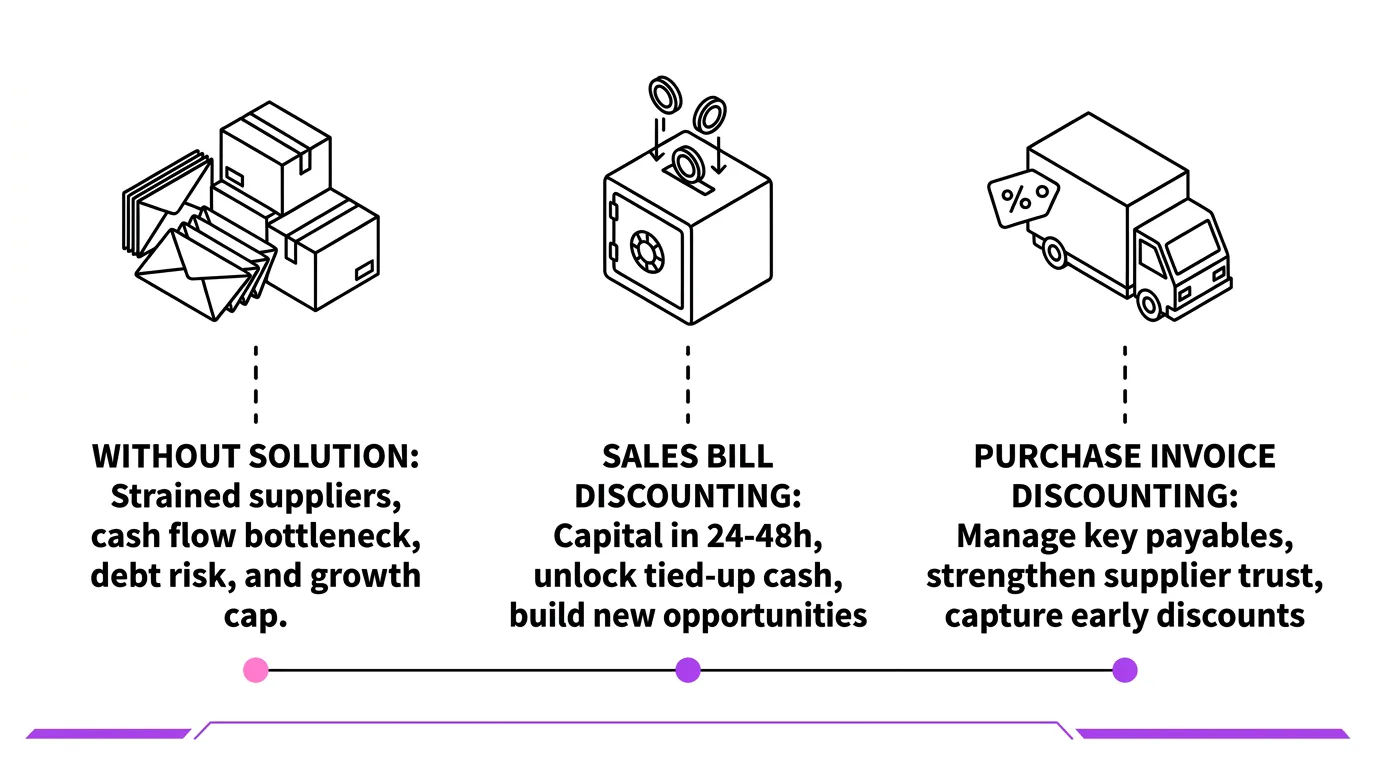
The solution recommended was Sales Bill Discounting — a facility that allowed the manufacturer to discount their approved invoices against these four customers and receive the funds within a day or two, rather than waiting out the full credit period.
No collateral was required. The invoices themselves — backed by the creditworthiness of the buyers — served as the security. The manufacturer was not taking on new debt. They were simply converting future receivables into present liquidity, on terms that made commercial sense.
“The receivables were always there. We just helped bring them forward.”
The Outcome: What the Money Actually Did
Within 24 to 48 hours of initiating the facility, funds were in the manufacturer’s account.
The immediate effect was practical: they could pay their own suppliers on time — and in some cases, ahead of schedule. Operational expenses were cleared. Statutory dues were met. Pending purchase orders moved forward. The manufacturing line, which had been running on edge, had room to breathe again.
But the less visible outcome was arguably more valuable.
Supplier relationships strengthened — because a vendor who gets paid on time is a vendor who prioritises your orders. Customer relationships held firm — because the manufacturer did not have to renegotiate terms with their OEM buyers. And that CFO question — whether they could ask their suppliers for another 30 days — became unnecessary. Working capital had been unlocked without stretching payables, without adding debt, and without any of the awkward conversations that come with asking for more time.

It is also worth noting that had the situation demanded it, ArthaVerse’s team could additionally have deployed Purchase Invoice Discounting — a complementary solution that would have unlocked even more liquidity on the payables side. The situation did not require it. But knowing that option existed was, itself, a form of financial resilience.
This client did come back — for more, and for different solutions. How ArthaVerse structured a CAPEX Financing solution for them is a story for another day.
The ArthaVerse Difference
Working capital problems in the MSME and manufacturing world are common. But they are rarely identical. A component manufacturer waiting on OEM receivables has a fundamentally different problem from an agri-tech company managing seasonal procurement cycles or an IT services firm chasing a government receivable.
At ArthaVerse, our Supply Chain Financing Solutions — spanning Sales Bill Discounting, Purchase Invoice Discounting, and more — are built around this reality. The solution is always structured around how the business actually operates, not around a standard product template. Our financial advisory team brings decades of combined experience across credit structuring, supply chain finance, and sector-specific financing — across manufacturing, FMCG, agri-tech, IT services, food processing, healthcare, and more.
All working capital problems call for cash flow. Not all of them call for the same solution. Ours are tailor-made.
“Capital flow across your value chain matters more than ever — and the right financing structure makes all the difference.”
Ready to explore what’s possible for your business?
Connect with ArthaVerse’s financial advisory team.
www.arthaverse.com | fintech@arthaverse.com | +91 76009 93429
The author, Henry Amalaraj – an expert from ArthaVerse’s financial advisory team – is an investment banker and a seasoned finance leader with over 35 years of industry experience across manufacturing, IT start-ups, public listed companies, and multinational corporations.

