
The Invoice Was Ready but The Payment Was Not — How an Indian IT Firm Turned a 60-Day Swiss Payment Cycle into a Growth Engine
Industry: Information Technology (IT)
Type of Company: Indian Software & IT Services Firm
Challenge: Working capital gap caused by a 60-day payment cycle from a European export client, stalling operations and new order fulfilment
Solution: Export Bill Discounting — €2 million raised against export receivables
Key Win: Read the case study to find out how this IT firm kept growing while waiting for its European payment to arrive
The Work Was Done. The Clock Had Just Started.
The code was written. The deliverables were signed off. The Swiss client — a well-established enterprise — was satisfied with the software product and services the Indian IT firm had delivered.
And yet, for the next 60 days, the revenue from that contract would simply not exist on the firm’s balance sheet. Not because there was a dispute. Not because the client was unreliable. But because that is how international payment cycles work in Europe: 60-day terms are standard, expected, and largely non-negotiable for an Indian exporter trying to compete in those markets. In fact, the payment cycle could even be 90 days (or more in rare cases) for some export clients.
For an IT firm with ambitions to grow its European presence, refusing those terms was not really an option. Insist on shorter payment windows and the client finds someone else. Accept them and the business runs on a 60-day lag — where every contract delivered creates a two-month gap between work done and money received.
“An invoice sent to Europe is not the same as cash in hand. Not for 60 days.”
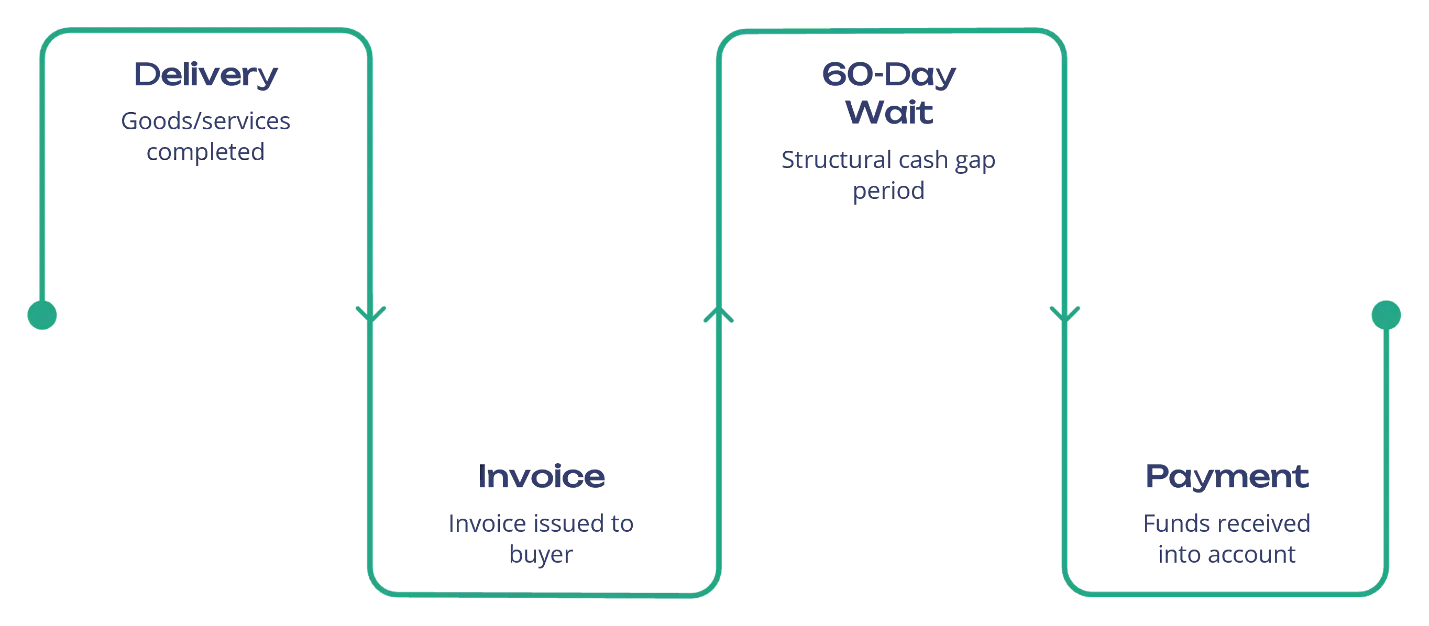
On its own, a single 60-day cycle is manageable. But for a software firm running multiple concurrent export engagements — each with its own payment timeline — the cumulative gap can become significant quickly. Developer salaries are monthly. Cloud infrastructure bills don’t wait. And the next client engagement requires onboarding, resourcing, and capital before a single euro from the previous one has cleared.
The firm’s order book was solid. Its European client relationships were real. The problem was purely one of timing — and timing, in cash flow terms, can quietly become an operational ceiling.
The Solution: Bringing the Money Forward
When the firm’s leadership connected with experts from ArthaVerse’s financial advisory team, the starting point was not a product recommendation. It was a conversation about the business — who the clients were, the nature of the export engagements, and the specific structure of the receivables sitting on the books.
What emerged was clear: the firm had a legitimate, verifiable export receivable from a creditworthy Swiss buyer. The invoice was real. The payment obligation was real. The only problem was the 60-day wait before that payment arrived.
The solution was Export Bill Discounting — a facility that allowed the firm to discount its outstanding export invoices and access the equivalent working capital immediately, without waiting for the payment cycle to run its course. The export receivables themselves formed the basis of the financing. No additional collateral was required. The firm was not taking on new debt — it was simply unlocking the value of work it had already delivered.
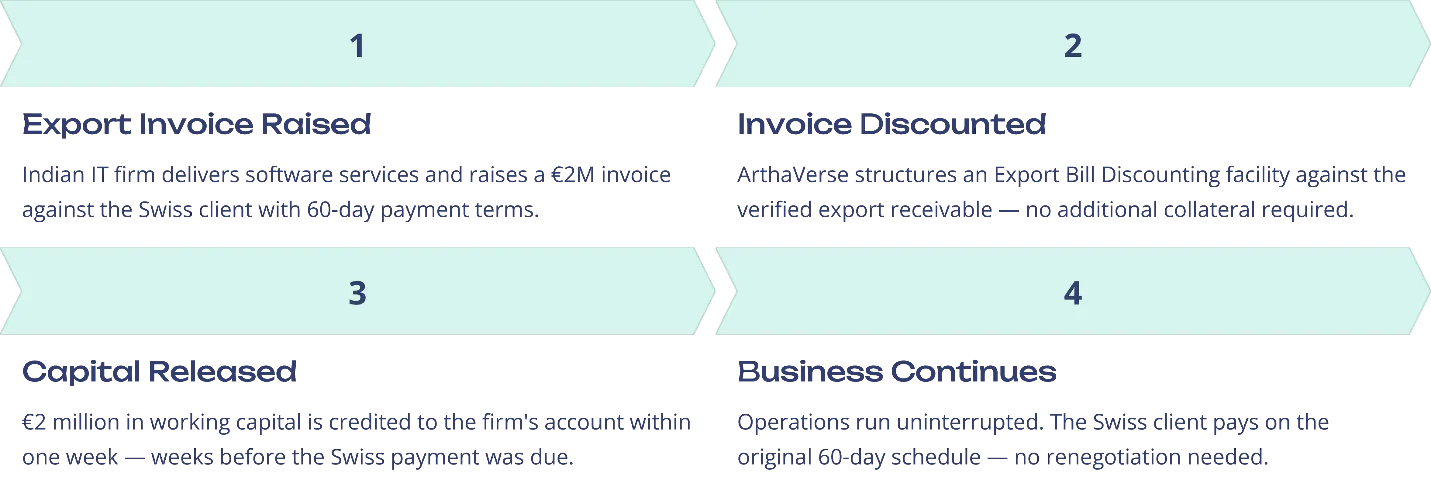
“The receivables were always there. Export Bill Discounting simply brought them forward.”
The process moved quickly. Within one week of initiating the facility, €2 million was in the firm’s account — released from invoices that would otherwise have remained locked in the payment cycle for another several weeks.
The Outcome: An Uninterrupted Business
The effect was immediate and practical. With working capital restored, the firm met all its operational commitments without disruption. Salaries were paid on schedule. Infrastructure and licensing costs were covered. The business did not have to scale back, pause deployments, or ask clients for anything different.
Most importantly, the firm was able to accept and fulfil further export orders — seamlessly. The next engagement was taken on without the shadow of a cash flow gap hanging over it. The 60-day payment cycle from Switzerland remained in place, because there was no longer any reason to renegotiate it.
€2M Unlocked in One Week
Export receivables converted to immediate working capital — no collateral, no long wait, no disruption to operations.
Business Continuity Maintained
Developer teams stayed deployed, infrastructure costs were met, and delivery commitments to European clients remained intact.
Export Pipeline Kept Moving
With liquidity restored, the firm accepted and fulfilled further export orders seamlessly, strengthening its European foothold.
There is a less visible dimension to this outcome that is worth noting. A software firm that can consistently deliver on large export contracts — without cash flow pressure affecting the quality of execution or the confidence of its team — builds something more durable than just revenue. It builds a reputation as a reliable export partner. That reputation, in turn, makes the next European client easier to win.
“Financial stability is not just an internal condition. It shows up in how a business delivers, communicates, and commits to the next engagement.”
The ArthaVerse Difference: Export Finance That Works for How IT Businesses Operate
The challenge this firm faced is one that many Indian exporters navigate — across IT, manufacturing, engineering services, and beyond. The export is completed. The buyer is creditworthy. The payment will arrive. But the business cannot wait 60 or 90 days for it to do so.
At ArthaVerse, our Export Finance Solutions —Export Bill Discounting in this case — are designed to close precisely this gap. Whether the exporter is a software company with receivables in Europe, a services firm with contracts in the Gulf, or a manufacturer shipping to buyers in East Asia, the core challenge is the same: capital locked in a payment cycle, and a business that needs to keep moving.
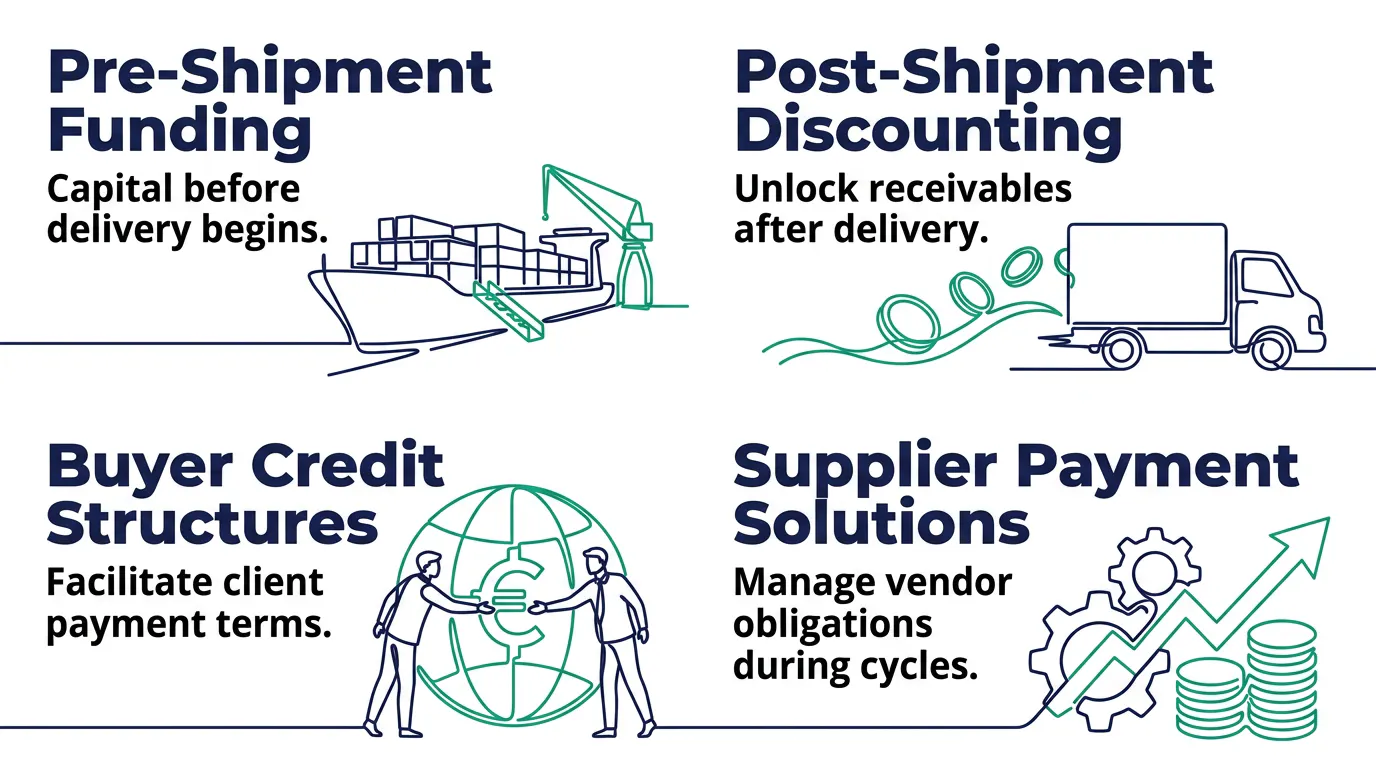
Our solutions address the full range of export and import financing requirements — from pre-shipment funding and post-shipment receivable discounting to buyer credit and supplier payment structures. And beyond export cycles, our working capital solutions extend to the broader spectrum of business financing needs: inventory funding, operational liquidity, CAPEX, and more. Whatever the source of the cash flow gap, there is a structured path to resolving it.
ArthaVerse’s financial advisory team brings together decades of combined experience across credit structuring, trade and export finance, supply chain solutions, and sector-specific financing — spanning IT/ITES, manufacturing, pharma, FMCG, agri-tech, healthcare, and more. They have navigated the edge cases, structured the non-standard facilities, and found working capital solutions where conventional lenders have not.
Because a business that has earned its receivables should not have to wait to use them.
“Every export receivable is working capital waiting to be released. The only question is whether you have the right structure to release it.”
Ready to explore Export Finance for your business?
Connect with ArthaVerse’s financial advisory team.
www.arthaverse.com | fintech@arthaverse.com | +91 76009 93429
About the Author
Henry Amalaraj – an expert from ArthaVerse’s financial advisory team – is an investment banker and a seasoned finance leader with over 35 years of industry experience across manufacturing, IT start-ups, public listed companies, and multinational corporations.

