
The SME Advantage: How Mutual Funds Identify High-Growth SME Stocks

In the evolving landscape of Indian capital markets, the SME segment in India has emerged as a powerful engine for wealth creation. With a growing number of SME stocks listed on NSE Emerge and BSE SME, investors are increasingly exploring SME investing opportunities for long-term growth. While SME stocks are often perceived as volatile, rising institutional participation–particularly from mutual funds–is bringing deeper research, stronger governance, and improved stability to this high-growth segment.
For investors seeking the next generation of high-growth companies, understanding how professional fund managers evaluate SME stocks and SME IPO opportunities can provide a valuable advantage. Institutional investors apply rigorous analysis to identify scalable businesses, strong promoters, and sustainable financial performance within the SME ecosystem.
As the dedicated SME exchanges in India continue to mature, select mutual fund schemes are gradually allocating capital to promising SME companies. This shift is transforming SME investing from a speculative niche into a structured investment opportunity. The following sections explore the key strategies and financial benchmarks used by experts to identify high-quality SME stocks with long-term growth potential.
How Mutual Funds Select SME Stocks: The Institutional Lens
Unlike large-cap investing, where information is symmetrical and widely available, SME investing in India is characterized by information asymmetry. Many SME stocks listed on SME exchanges such as NSE Emerge and BSE SME have limited analyst coverage. Fund managers bridge this gap through a "boots-on-the-ground" approach and a rigorous multi-layered SME stock selection strategy.
1. The "Scalability" Litmus Test
A primary focus for fund managers when evaluating SME stocks in India is the company’s ability to scale. They look for "Big Fish in Small Ponds"–SMEs that hold a dominant position in a niche market or a specialized manufacturing vertical. The strategy involves identifying businesses where a small infusion of capital (often from SME IPO proceeds) can lead to exponential capacity expansion or geographical reach, making them attractive high-growth SME companies.
2. Management Integrity and Skin in the Game
In the SME ecosystem, the promoter is the business. Institutional investors and mutual fund managers investing in SME stocks conduct deep-dive due diligence on management quality. They prioritize:
- Capital Allocation History: How has the management used debt and internal accruals in the past while growing the SME business?
- Succession Planning: Is there a professional structure beyond the founder that supports long-term SME company growth?
- Pledge and Stake: High promoter holding with zero pledges is often a non-negotiable prerequisite for institutional investment in SME stocks.
3. Sectoral Tailwinds and Resilience
Fund managers often adopt a Top-Down investment approach to identify sectors benefiting from government initiatives (like PLI schemes or the 'Make in India' initiative) that support SME sector growth in India. Once a favorable sector is identified, they use a Bottom-Up approach to pick the most efficient player within that niche among listed SME companies.
The Fundamentals of a "Quality" SME Stock
For investors looking to align their perspective with professional fund managers, certain fundamental SME stock fundamentals and financial "green flags" distinguish high-quality SME stocks in India from the rest of the pack listed on SME exchanges such as NSE Emerge and BSE SME:
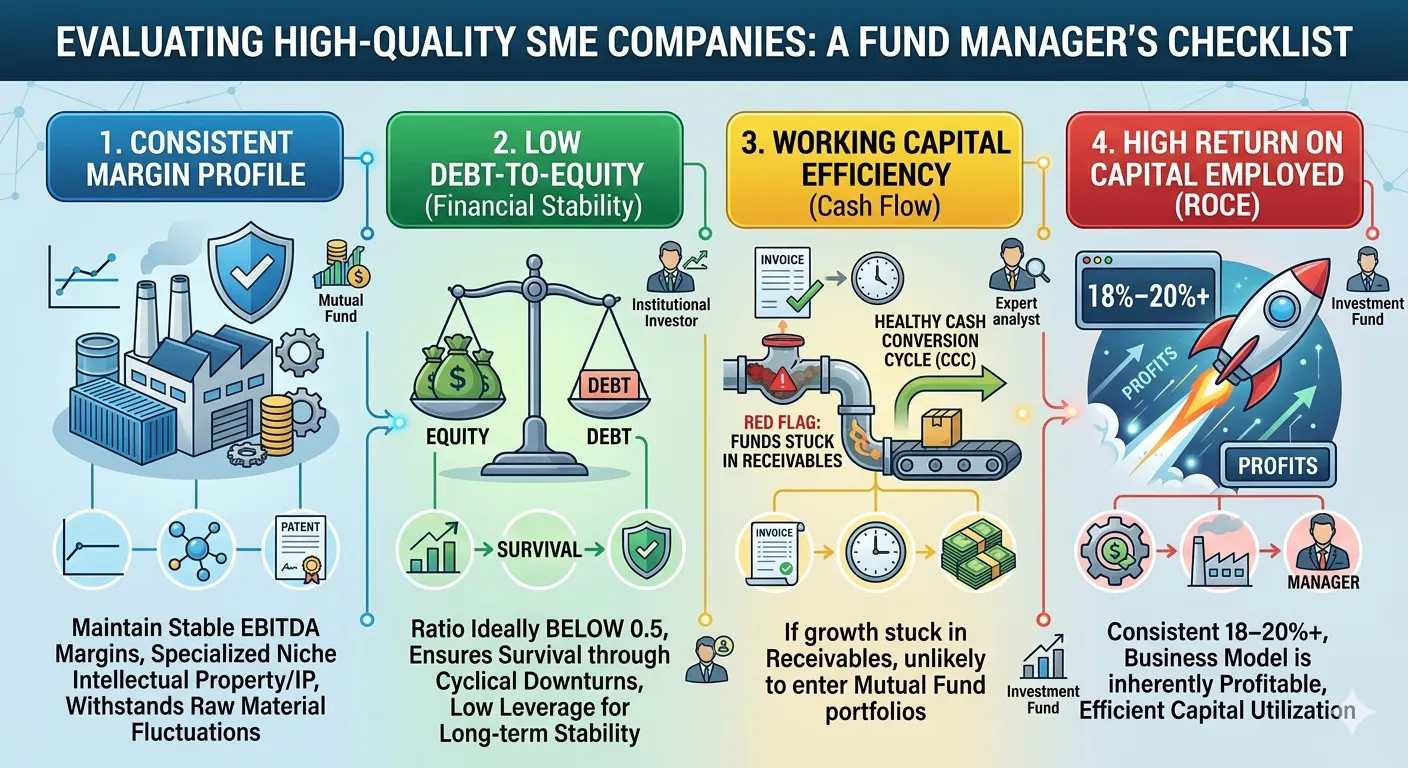
- Consistent Margin Profile: Quality SME companies often possess specialized technical know-how or niche intellectual property that allows them to maintain stable EBITDA margins, even during raw material fluctuations. This consistency is a key indicator used by mutual funds and institutional investors evaluating SME stocks.
- Low Debt-to-Equity: High leverage is the biggest risk in SME investing. Fund managers gravitate toward SME stocks with a Debt-to-Equity ratio ideally below 0.5, ensuring the SME business can survive cyclical downturns and maintain financial stability.
- Working Capital Efficiency: A "Red Flag" often found in SME companies is growth stuck in "Receivables." Experts analyzing SME stock fundamentals look for businesses with a healthy Cash Conversion Cycle (CCC). If a company is growing top-line but failing to convert sales into cash, it rarely makes it into a mutual fund or institutional SME investment portfolio.
- Return on Capital Employed (ROCE): A consistent ROCE of 18–20% or higher is a hallmark of a high-quality SME stock. It indicates that the business model is inherently profitable and that management is efficient in utilizing capital—an important metric for mutual funds investing in SME stocks in India.
The Investor’s Takeaway
Investing in listed SME stocks in India via Mutual Funds–or by following their SME stock selection philosophy–offers a balanced path to capturing the growth of “tomorrow’s mid-cap companies.” The SME investing segment is no longer just about speculative gains; it is increasingly becoming a structured asset class driven by strong SME stock fundamentals, institutional participation, and rigorous analysis.
As the Indian economy moves toward the $5 trillion milestone, the listed SME space on exchanges like NSE Emerge and BSE SME remains one of the most fertile grounds for identifying the next generation of high-growth companies and future market leaders. For the long-term investor, the SME investing strategy is clear: focus on quality SME stocks, demand transparency, and prioritize sustainable business growth over short-term market momentum.

