
When Debt Earns You Money
How a Paper Manufacturer Turned a 1.5% Monthly Interest Rate into a 2% Net Profit
Sector: Paper Manufacturing
Challenge: Zero Working Capital
Facility: Purchase Invoice Discounting
Key Win: Read the Case Study (below) to find out
Most business owners treat debt as a necessary evil — a cost to be minimised and repaid as quickly as possible. But what if the right financing structure could do more than just plug a gap? What if it could actually make you money?
That’s exactly what happened to a mid-sized paper manufacturer in India who came to the experts of ArthaVerse’s financial advisory team with a problem that seemed straightforward on the surface: they had a large Purchase Order in hand, zero working capital to buy raw materials, and a business that couldn’t move until both problems were solved simultaneously. What they left with was a financing structure that not only solved their cash flow crisis but also created a genuine arbitrage opportunity that improved their margins on every single procurement cycle.
The Problem — A Live Order, a Stalled Business
The paper manufacturer had done everything right. They had won a significant Purchase Order from a reputable buyer. Their production capacity was ready. But the working capital to purchase raw materials simply wasn’t there — and without raw materials, none of the rest of it mattered.
Although this manufacturer’s suppliers, like most in the sector, operated on 60-day credit terms, there was no liquidity buffer and, hence, the entire order — and the revenue attached to it — was at risk of slipping away.
A traditional bank loan wasn’t a practical option here. The approval timelines were too long, collaterals requirements were a problem, and the cost of a standard working capital facility, once properly accounted for, ate heavily into already thin paper-sector margins. The business needed capital, but it needed it on terms that made commercial sense.
“An order won but unfulfilled is no different from no order at all.”

The Solution — Purchase Invoice Discounting
When the promoters connected with experts from ArthaVerse’s financial advisory team, the recommendation was immediate and precise: Purchase Invoice Discounting. Rather than taking on a traditional loan, the manufacturer would use ArthaVerse’s supply chain financing facility to pay their suppliers early — immediately, in fact — against the invoices they had raised. The financial institution behind the facility would settle the supplier on Day 1. The manufacturer would repay within the 60-day credit cycle. The interest cost: 1.5% per month, or 3% for the full two-month period.
On the surface, this looks like a standard financing transaction. But ArthaVerse’s team identified a strategic move that transformed it into something altogether different.
The Negotiation — Turning Interest into Profit
Because the manufacturer could now offer their supplier immediate payment, they held genuine commercial leverage. Suppliers almost universally prefer early payment; it improves their own cash flow and removes collection risk.
ArthaVerse’s advisors guided the manufacturer to negotiate a 5% cash discount in exchange for that early settlement.
The arithmetic that followed was the kind that changes how a business thinks about its financing:

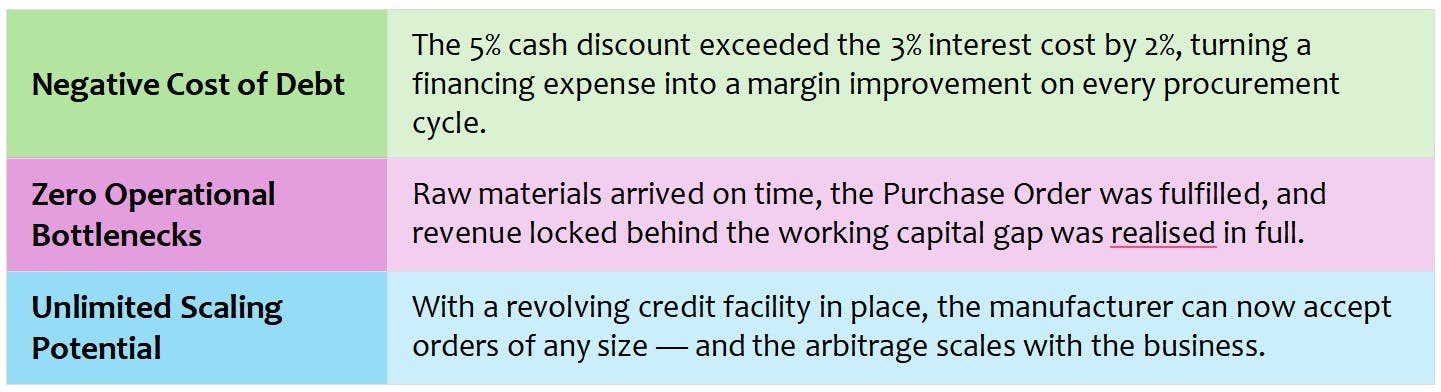
The financing didn’t just pay for itself — it generated a 2% net return on the value of every procurement cycle. The cost of capital turned negative. The debt became a profit centre.
The Outcome — Three Things Changed Permanently
The impact of this financing structure went well beyond solving an immediate cash flow problem. Three things shifted in a lasting way for the business:
“Stop looking at the interest rate. Start looking at the arbitrage opportunity.”

The ArthaVerse Difference — Financing Structured Around Your Reality
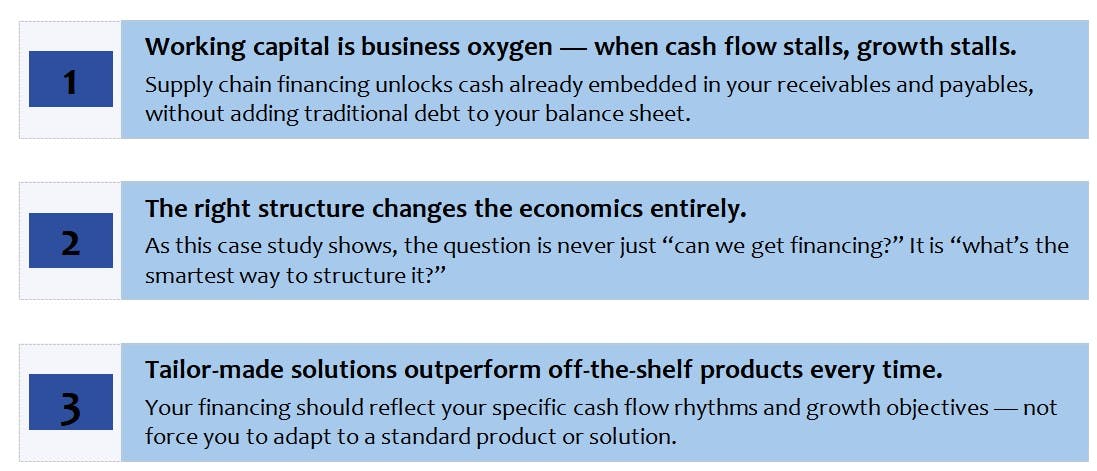
The paper manufacturer’s story is not unique in its challenge — cash-strapped businesses with live orders are one of the most common working capital problems we see. What made the difference was not simply that financing was found. It was that the right kind of financing was structured around the specific commercial dynamics of the business.
At ArthaVerse, we understand that no two working capital problems are identical. A paper manufacturer dealing with 60-day procurement cycles has a fundamentally different problem from a pharma exporter waiting on foreign receivables. A one-size-fits-all solution will always leave gaps. What's needed is creative financial thinking, deep sector knowledge, and the experience to know which lever to pull — and when.
Our supply chain financing solutions are designed precisely for this. Whether it’s Sales Bill Discounting to unlock receivables, Purchase Invoice Discounting to pay suppliers strategically, or Export Bill Financing for early payment realization, we structure each solution around how the business actually operates — not a standard product template.
ArthaVerse’s financial advisory team’s experts bring decades of combined experience across credit structuring, supply chain finance, export trade cycles, and CAPEX financing — across manufacturing, FMCG, pharma, IT/ITES, agri-tech, healthcare, and more. They have seen the edge cases, the hidden opportunities, and the under utilised structures that can unlock capital.
Ready to transform your business cash flow?
Let ArthaVerse’s financial advisory team assess your situation and build a financing structure that works for your business — not against it. Schedule a consultation, no obligation.
www.arthaverse.com | connect@arthaverse.com | +91 76009 93429
The author, Henry Amalraj – an expert from ArthaVerse’s financial advisory team – is an investment banker and a seasoned finance leader with over 30 years of industry experience across manufacturing, IT start-ups, public listed companies, and multinational corporations.

