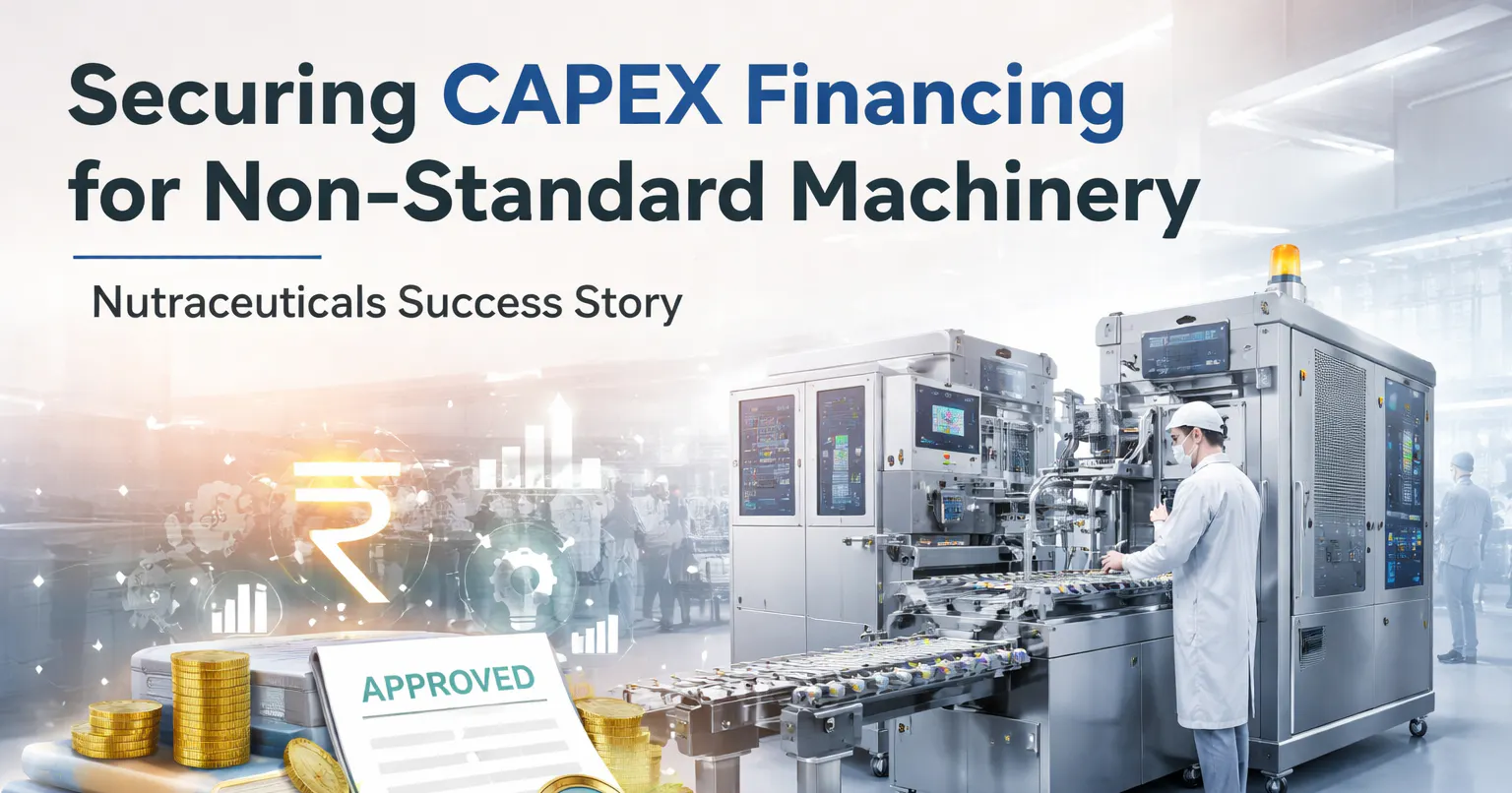
When “Non-Standard” Was the Wrong Label:
How a Nutraceuticals Company Financed a ₹2 Cr Machine No Bank Would Touch
Industry: Health & Wellness
Sector: Pharma Foods (Nutraceuticals)
Challenge: Financing a locally customised production machine classified as “non-standard equipment” by most financial institutions
Solution: CAPEX Finance — structured using cross-industry technical specifications
Key Win: Read the case study to find out how this financing barrier was broken — and what it unlocked for the business
The Machine That Could — But Wouldn’t Get Financed
For a growing nutraceuticals company operating in India’s Health & Wellness space, expansion was not a question of will. Demand for their products was rising, the team was in place, and the production line was running. The only constraint was output — and output needed a machine.
Specifically, a highly specialised piece of production equipment. One that would meaningfully increase manufacturing capacity and position the company to serve a larger, more demanding market. The machine existed. The business case for acquiring it was clear. What was missing was the financing to bring it in.
The original specification pointed to an imported machine, which would cost ₹7 crore. For an MSME-scale manufacturer, that figure was prohibitive. It wasn’t just a capital allocation problem — it was a conversation stopper. An import of that size, on the balance sheet of a business at that stage of growth, simply wasn’t viable.
Then came a more practical option. A local machinery manufacturer, familiar with the company’s requirements, stepped forward with an offer: a customised, locally manufactured equivalent, built to the same functional specifications, for ₹2 crore. The savings were dramatic. The engineering solution was sound. The business decision seemed clear.
Except that the financing didn’t follow.
The Classification Problem: A Label That Closed Doors
When the nutraceuticals company approached financial institutions to fund the ₹2 crore machine, the response was consistent — and consistently frustrating. Institution after institution declined.
The reason? The locally customised machine did not fit neatly into any standard equipment category recognised by most lenders. In the nutraceuticals and pharma foods sector, the machine was considered “non-standard equipment.” Lenders rely on standardised equipment classifications to assess residual value, marketability, and financing risk. When a machine falls outside those categories, most institutions simply walk away — not because the business is weak, but because the asset doesn’t fit a pre-approved box.
“Banks don’t just assess businesses. They assess assets. And an asset with the wrong label rarely makes it past the first review.”
For a company that had already done the hard work — identifying the right machine, negotiating a cost-effective local alternative, and validating the business case — this was a deeply frustrating impasse. The machine was real. The need was real. The savings over the imported alternative were real. But the label attached to it was blocking every door.

The Solution: Reframing the Asset, Not the Business
When the nutraceuticals company connected with ArthaVerse’s financial advisory team, the first move was not to find a lender willing to overlook the issue. It was to examine whether the issue itself was accurate.
The team asked a simple but powerful question: was this machine truly “non-standard” — or was it only classified that way within the specific lens of the nutraceuticals sector?
The answer, as it turned out, changed everything.
A cross-sector review of the machine’s specifications revealed that the same equipment — functionally identical in design and application — is widely used in the packaging industry, where it is classified as standard equipment. The machine wasn’t unusual. It wasn’t custom in the way lenders feared. It was simply being viewed through the wrong industry lens.
“The machine wasn’t non-standard. It was being evaluated by an incorrect or ‘different’ standard.”
ArthaVerse’s team prepared a detailed technical representation anchored in packaging-industry specifications and nomenclature — the same machine, reframed through the classification system in which it was, in fact, entirely standard. This documentation was presented to a financial institution willing to evaluate the asset on its actual merits.
The financial institution (FI) reviewed the case, accepted the cross-industry classification rationale, and sanctioned the financing.
The ₹2 crore machine had found its backer.

The Outcome: Capacity Unlocked. A Partnership Deepened
The machine was commissioned successfully. Production capacity increased — exactly as the business had intended. What had been an operational ceiling was replaced by a new, higher floor.
But the outcome extended beyond the production floor.
For ArthaVerse, the success of this engagement was twofold: the client’s growth objective was met, and the relationship deepened. The company came back — not just satisfied, but confident that ArthaVerse could be relied upon to solve financing problems that others had turned away.
“The best outcome of a well-solved problem is that the client trusts you with the next one.”
The ArthaVerse Difference: CAPEX Financing Built Around the Real Asset
The nutraceuticals company’s challenge is one that many businesses encounter — not because their assets are genuinely unfinanceable, but because they are being evaluated through the wrong framework.
At ArthaVerse, our CAPEX Financing Solutions are designed to cut through classification barriers and structure financing around the real commercial and technical merits of the asset. Whether the requirement involves —
• New equipment or plant and machinery
• Infrastructure creation or enhancement
• Capacity expansion or production upgrades
• Technology or software upgrades to drive operational efficiency
• Diversification into new product lines or business verticals
— we structure solutions that align with the asset’s actual lifecycle, the business’s revenue generation pattern, and the commercial realities on the ground.
Beyond CAPEX Finance, ArthaVerse’s financial advisory team also addresses the full spectrum of working capital requirements — from supply chain financing and invoice discounting to export finance and revolving credit structures. Growth is rarely a single-dimension challenge, and our solutions are built to match that complexity.
Our financial advisory team brings decades of combined experience across credit structuring, CAPEX and asset financing, supply chain finance, and sector-specific solutions — spanning manufacturing, pharma, nutraceuticals, healthcare, IT/ITES, agri-tech, FMCG, and more. They have seen the edge cases, navigated the classification issues, and identified the financing pathways that standard lenders routinely miss.
Because when a business is ready to grow, the only acceptable answer is to find a way to fund it.
“Every CAPEX requirement has a solution — provided you know where to look, and how to frame the question.”
Ready to explore CAPEX Financing for your business?
Connect with ArthaVerse’s financial advisory team.
www.arthaverse.com | fintech@arthaverse.com | +91 76009 93429
Henry Amalaraj – an expert from ArthaVerse’s financial advisory team – is an investment banker and a seasoned finance leader with over 35 years of industry experience across manufacturing, IT start-ups, public listed companies, and multinational corporations.

