

My Experiences with Franchising

When people ask me what I do, I usually tell them that I am a franchise professional. But when I look back at a career spanning more than three decades, that description seems too simple. Franchising has taken me across India and into different countries, through hundreds of stores and into the lives of thousands of entrepreneurs. I have seen people start with very little and build successful businesses, and I have also seen people put their savings into a franchise and lose money because they did not ask the right questions before investing. I have worked with education brands, salons, beauty businesses, retail concepts and several other categories. I have helped brands enter new cities, new states and new countries, and at one stage I was travelling from Jammu to Kanyakumari trying to build franchise networks. Through all these experiences, one principle has become very clear to me: franchising is not about selling franchises; it is about building a business that another person can successfully operate. There is a big difference between the two.
I Started as a Salesman
My journey did not begin with franchising. Way back in 1990, I started my career in Visakhapatnam with DSRC, Data Software Research Company, where I joined as a computer education instructor. I liked computers, but I soon discovered that teaching computers was not something I enjoyed. When an opportunity came for me to move into sales, I took it and very quickly realised that I loved the profession.
Salespeople fascinated me in those days. A successful salesman would carry a good bag, wear a tie, polish his shoes properly and speak confidently. My boss, Hari Natarajan, was someone I particularly admired. Whenever he visited us, I noticed the way he dressed, spoke and conducted himself, and as a young man I wanted to become like him.
There was, however, one thing about the popular image of sales that bothered me. There was an old Tamil joke about salesmen: kaiyil pai, kazhuthil tie, naakil poi — a bag in the hand, a tie around the neck and a lie on the tongue. I could accept the bag and the tie, but I could not accept the lie. My father had taught me very clearly that I should not lie, and that teaching had gone deep into me.
Even though I enjoyed selling, somewhere inside me was the question: can you really be a successful salesman without exaggerating or misleading the customer?
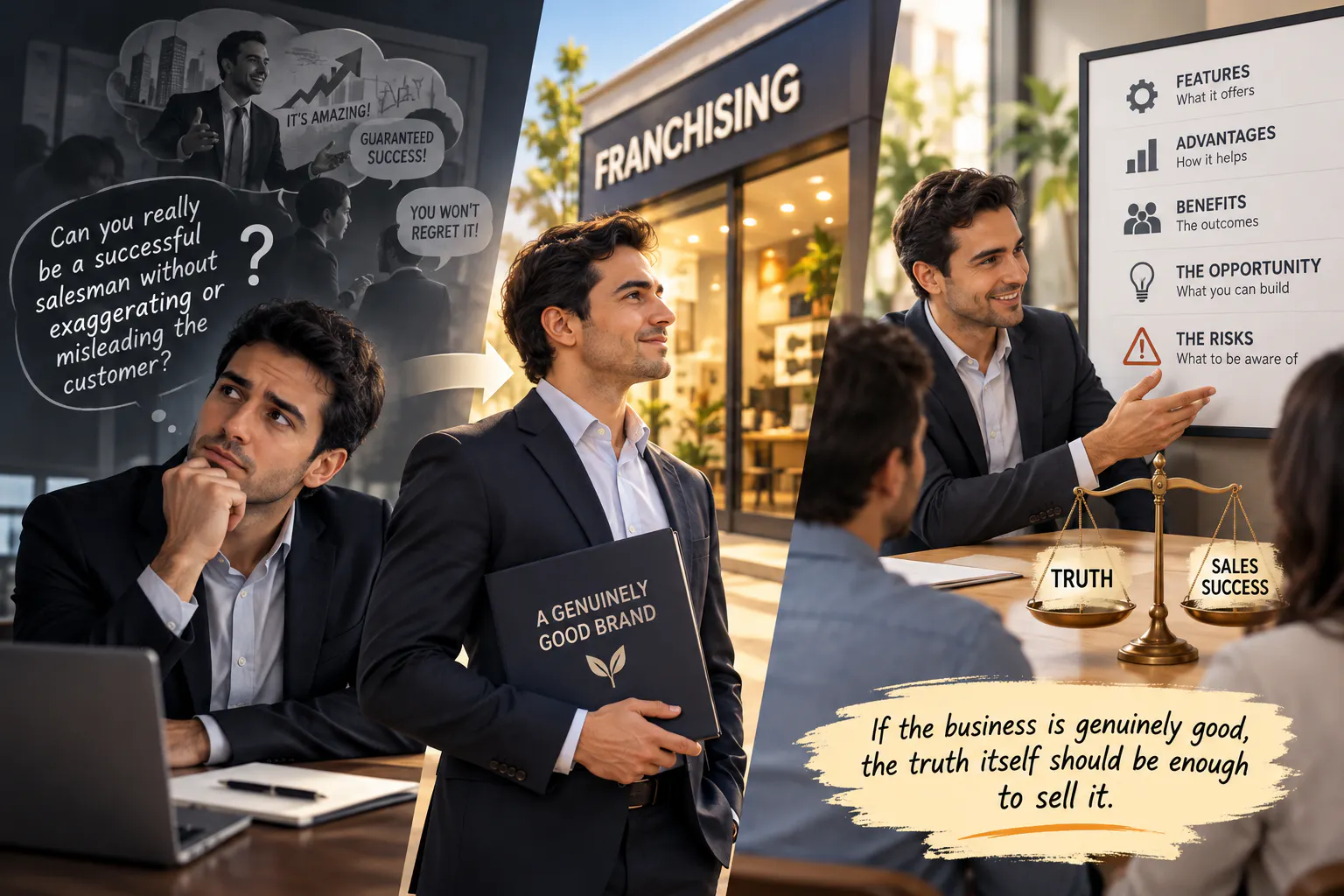
Franchising eventually gave me my answer. If I represent a genuinely good brand, I do not have to manufacture a story around it. I can explain its features, advantages and benefits, talk about the opportunity and also be open about the risks. If the business is genuinely good, the truth itself should be enough to sell it. That philosophy has stayed with me throughout my career.
A Franchise Is Somebody Else’s Money and Somebody Else’s Dream
This is something I wish more franchisors understood. When somebody buys your franchise, you may see a franchise fee coming into your company, but that is not how the franchisee sees it. For him, it may represent ₹10 lakh, ₹30 lakh, ₹50 lakh or even ₹1 crore of his family’s money. It may be his savings, a bank loan, or money that his wife and parents have agreed to put into the business.
Along with that money comes a dream. He may be thinking that if this business succeeds, he can build a house, educate his children or finally leave his job and become an entrepreneur. Once you understand this, franchising becomes a responsibility rather than merely another way of raising money for expansion.
I have met franchisees from my earlier years who used to travel on two-wheelers and who later bought good cars and built their own houses. Seeing that gives me enormous satisfaction. Their success, of course, belongs to them because they worked hard for it, but the brand provided them with a platform on which that hard work could produce results. That, to me, is what good franchising can do.
Unfortunately, I have also seen the opposite. I have seen businesses that were primarily interested in collecting franchise fees. They sold the franchise, gave the entrepreneur a board to put outside his shop and then practically disappeared. That is not franchising.
The Front End Can Fool You
One lesson I have learnt over the years is never to judge a franchise by its front end. A nice logo can be designed, beautiful photographs can be taken, an impressive presentation can be created and social media can make a six-month-old business look like a national brand. Whenever I evaluate a company, therefore, I am far more interested in what is happening behind the curtain.
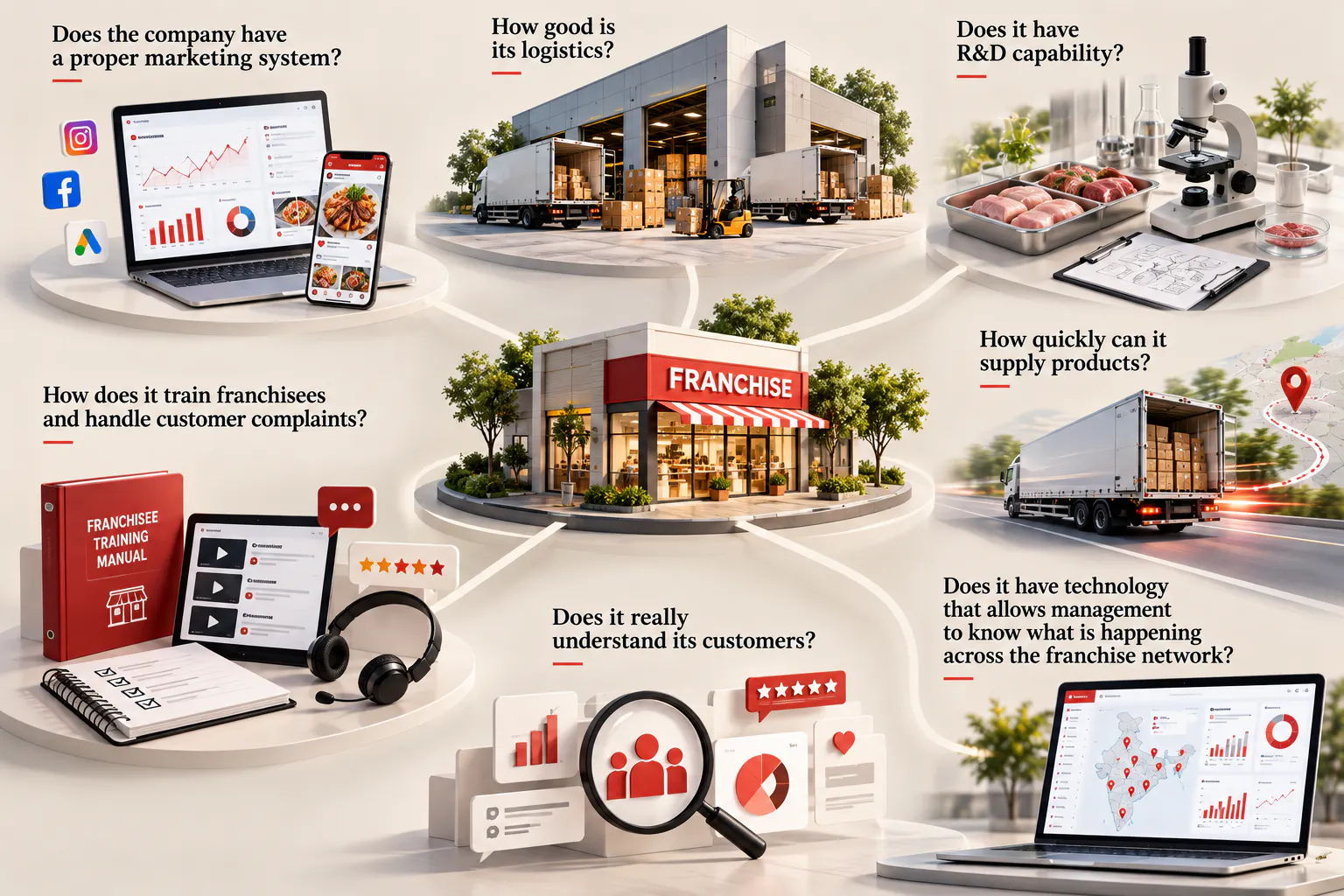
I want to know what the backend looks like.
- Does the company have a proper marketing system? How good is its logistics?
- Does it have R&D capability?
- How quickly can it supply products?
- How does it train franchisees and handle customer complaints?
- Does it really understand its customers?
- Does it have technology that allows management to know what is happening across the franchise network?
Most importantly, I want to know whether the franchisor himself is making money.
I sometimes tell prospective franchisees that one of the first questions they should ask is very simple: “Sir, are you profitable?” People hesitate to ask this, but I don’t understand why. You are putting your own money into the business, so you have every right to ask about its financial viability.
In fact, I encourage franchisees to ask more questions. If the franchisor becomes uncomfortable because you are asking intelligent questions, that itself tells you something. A strong franchisor should enjoy answering a good prospective franchisee’s questions because every satisfactory answer creates greater clarity and, with that clarity, greater confidence in associating with the brand.
Franchising Looks Easy Only from the Outside
People sometimes think franchising is an easy way to grow a company: open one successful shop, make a franchise brochure, put some advertisements on Instagram and start selling territories. In reality, behind every successful franchise network is an enormous amount of work that the customer and even the franchisee may never see.
You need marketing, logistics, training, manpower, product development and R&D. Today you also need technology. AI and integrated software systems are changing the way companies understand their consumers, and a serious franchisor needs systems capable of telling him what is happening throughout the network.
Imagine operating 100 stores, then 500 and eventually 1,000. You need to know which stores are performing well, which products are moving, where customers are unhappy, where inventory is stuck and which franchisee needs intervention. A large network cannot be managed through telephone calls and spreadsheets alone. That is why I have always believed that the franchise itself is not the business model; the system behind the franchise is the business model.
Building CADD Centre Taught Me What Scale Really Means
One of the most important experiences of my career was with CADD Centre. At the time, I was given the responsibility of establishing a South Indian brand in North India. Today we speak casually about pan-India brands, but the market was very different then. Taking a Chennai-based education company into North India was not easy because there were already established competitors, consumer behaviour differed and the education market itself was different.
My boss, Mr. Parthasarathy, told me, “Chacko, somehow go there and establish it.” I was not immediately confident. There was a genuine fear in me about whether a person sitting in South India could go north and successfully build such a network. I finally agreed on the condition that I would spend around 15 days there and then return to Chennai before going back again. He accepted the arrangement and gave me the opportunity.

What followed became one of the great learning experiences of my life. I travelled extensively, from Jammu to Kanyakumari, and during my period with the company we eventually developed around 350 CADD Centres. That number sounds impressive when you say it today, but every number has a story behind it. There were days when I travelled around unfamiliar towns in rickshaws wearing a tie because that was part of our professional culture. There were long journeys, difficult meetings, rejections and countless conversations with people who had never heard of us.
That experience taught me something no textbook could have taught me: expansion happens one relationship at a time. People see 300 stores; the franchise professional remembers what it took to establish the first one.
When the Journey Became Dangerous
Some memories from those years have nothing to do with boardrooms. On one occasion, my colleague David Paul and I travelled to Guwahati. Around the time we reached there, there had been a terrorist shootout, and when we reached the hotel there was a body lying there. I called my boss and explained what had happened. He told me to come back, but the problem was that we couldn’t go anywhere. We remained there until the situation settled and eventually resumed our work.
On another occasion, while travelling towards Jammu at night, our bus suddenly stopped. There was confusion, people were shouting in Hindi, and we realised that an encounter involving terrorists was taking place nearby. We could hear firing. At that moment you are obviously not thinking about franchise targets; you are wondering whether you are going to get home safely. Looking back today, however, even those difficult incidents have become part of the memories of an extraordinary period in my life.
My boss also taught me another lesson that made all this travel enjoyable. Whenever I travelled somewhere for work, he would tell me, “Don’t go there only for work. Stay one more day and see the place.” Because of that advice, work took me to the Golden Temple, Jallianwala Bagh, the Taj Mahal and many other places that I had previously encountered only in history books.
Perhaps that is another reason I remained in franchising for so long. I loved sales, meeting people, building businesses and travelling, and franchising somehow brought all of these together.
The First Store Is Always the Hardest
Years later, my work gave me opportunities to help Indian brands expand internationally. With Naturals, for example, I was involved in taking the brand into six countries. International expansion sounds glamorous after it has happened, but before it happens there is mostly uncertainty.
You enter another country where people may not know your brand, identify the right partner, understand the market and decide whom you should approach first. One important lesson I learnt was the value of the Indian diaspora, which can provide an Indian brand with its first bridge into an overseas market. Even then, simply saying “target the diaspora” is not enough. You have to understand which community you should approach, who the influencers are, whom you should associate with and why somebody in Dubai or another international market should choose your Indian brand.
Once the first store succeeds, however, something interesting begins to happen: people start approaching you. I have seen this repeatedly. The first outlet requires enormous effort, but once customers accept it and the economics work, the second, third and fourth stores become easier. In a well-built franchise system, success itself starts recruiting franchisees.
Location Can Make or Break a Good Franchise
Even a very good brand can fail in the wrong location, which is why I have always believed that location selection should be scientific. You cannot simply say, “This shop is available and the rent looks reasonable.”
You need to understand who lives around the location, the size and nature of the catchment, traffic patterns, visibility, parking, customer demographics and the other brands operating nearby. Once you identify the right location, the work still isn’t over. The interiors, ambience, staff and customer experience all have to match the brand, and finally you have to generate walk-ins.
A store does not become successful merely because you put a famous brand name on the board. Customers still have to come through the door, buy something and return. That is why franchising ultimately brings marketing, operations, logistics, training, technology, people management and customer experience together.
Small Investment Does Not Mean Small Risk
Today I regularly see advertisements saying that somebody can open a tea shop for ₹3 lakh or ₹4 lakh. There is nothing wrong with a tea shop; tea can be a fantastic business, and India has some beautifully built tea brands. My concern begins when advertisements make entrepreneurship look effortless: “Pay ₹3 lakh and we will give you everything.”
The entrepreneur should immediately ask what “everything” means. Who will generate customers? What is my gross margin? What will my rent and manpower costs be? How many cups must I sell every day to break even? What support will the franchisor provide, and what happens if the outlet doesn’t work?
People sometimes assume that because the investment is ₹3 lakh, the risk is also small. But for someone whose total savings are ₹5 lakh, ₹3 lakh is certainly not a small investment. The amount is relative. Whether a franchise costs ₹3 lakh or ₹1 crore, the principle remains the same: understand the business before you buy the franchise.
India Is Only Beginning Its Franchise Journey
When you travel in the US, UK, Australia or parts of Europe, you see how deeply franchising and organised retail have developed. Systems and processes have made scale possible. India is moving in the same direction, although in its own way.
Look at our tea shops, salons, preschools, gyms, food outlets and retail businesses. Categories that were once almost entirely unorganised are becoming branded. During my career, I have watched these franchise cycles change. There was a period when IT education was everywhere, with brands such as NIIT and Aptech. Then preschools became a major category, followed by rapid expansion in salons and beauty.
Today it is difficult to identify just one dominant category because almost anything can become a franchise if there is a genuine business model behind it. I have even received enquiries about concepts such as blouse stitching. Indian entrepreneurs are looking at ordinary consumer needs and asking whether these activities can be organised, branded and replicated. I believe that is where a large part of the future opportunity lies.
Don’t Franchise Too Early
This is also where I give entrepreneurs a warning. Just because one outlet is successful does not mean you are ready to franchise.
First prove the business, understand its economics and build the supply chain. Document the operating processes, develop training systems, create a marketing engine and put the necessary technology in place. Only then should you start seriously thinking about franchising.
I sometimes see businesses that were born yesterday trying to sell franchises today. Some have not even created a real brand; they have created a presentation and a franchise package. That is dangerous because the franchisee should not be the person who finances the franchisor’s experimentation. The franchisor should have done enough experimentation before taking somebody else’s money.
Build a Legacy, Not a Franchise-Selling Machine
I admire brands that think in generations. A founder should be able to say, “I want my children and my children’s children to see this brand.” Look at businesses that have survived for decades. They survived because somebody patiently built them over time.
This is what I call a legacy mindset. If your objective is to collect as many franchise fees as possible in two years, your decisions will look one way. If your objective is to build a brand that will still exist 30 years from now, you will make very different decisions.
You will care about franchisee profitability, product quality and customer experience. You will reject bad locations and may even refuse money from somebody because you know that person is not the right franchise partner. One of the lessons experience teaches you is that sometimes not selling a franchise is good franchising.
Why I Still Love This Business
After more than 35 years, people sometimes ask why I am still so passionate about franchising. The answer is that I still enjoy seeing businesses grow and meeting entrepreneurs. I enjoy taking a concept and thinking about how it can become 10 stores, then 100 and perhaps 500.
Franchising has also allowed me to remain involved in many different aspects of business. I enjoy marketing and sales, but I am equally interested in operations, training, logistics and understanding why one location works while another doesn’t. Few professions would have allowed me to participate in so many different parts of a business.
That is also why I eventually pursued academic research in franchising. I had accumulated decades of practical experience, but experience sitting inside one person’s head has limited value. It needs to be documented, structured and taught. That thinking led me to pursue my doctorate and later work towards creating more structured franchise-management education.
As more Indian brands expand nationally and internationally, passion alone will not be enough. We will need professional franchise managers who understand franchise development, unit economics, operations, marketing, partner management and systems. My hope is that the next generation will build Indian brands that do not merely reach 100 stores in India but eventually operate 1,000 stores across several countries.
Never Forget the Franchisee
If I had to reduce more than three decades of experience to one lesson, it would be this: never forget the franchisee.

It is very easy for a growing company to become obsessed with numbers. We have reached 50 stores. We have reached 100. Our target is 500. Those milestones are important, but behind every number is an entrepreneur who has invested his money, time and hopes in the brand.
Instead of only asking how many stores you have opened, ask whether the franchisees are making money. Ask whether they are happy, whether they would invest in another outlet and whether they would recommend the franchise to their brother or a close friend. The answers to those questions will tell you far more about the health of the franchise system than a presentation showing the total number of stores.
I entered this field as a salesman who did not want to lie. More than three decades later, I believe the same principle still works. Build a good business, tell people the truth about it, create systems that help them succeed and stand with them when the business becomes difficult. If you do these things consistently, expansion will follow.
Ultimately, franchising is not about putting your board on somebody else’s shop. It is about giving another entrepreneur a business worth building his life around.
— Dr. Chackochen Mathai

