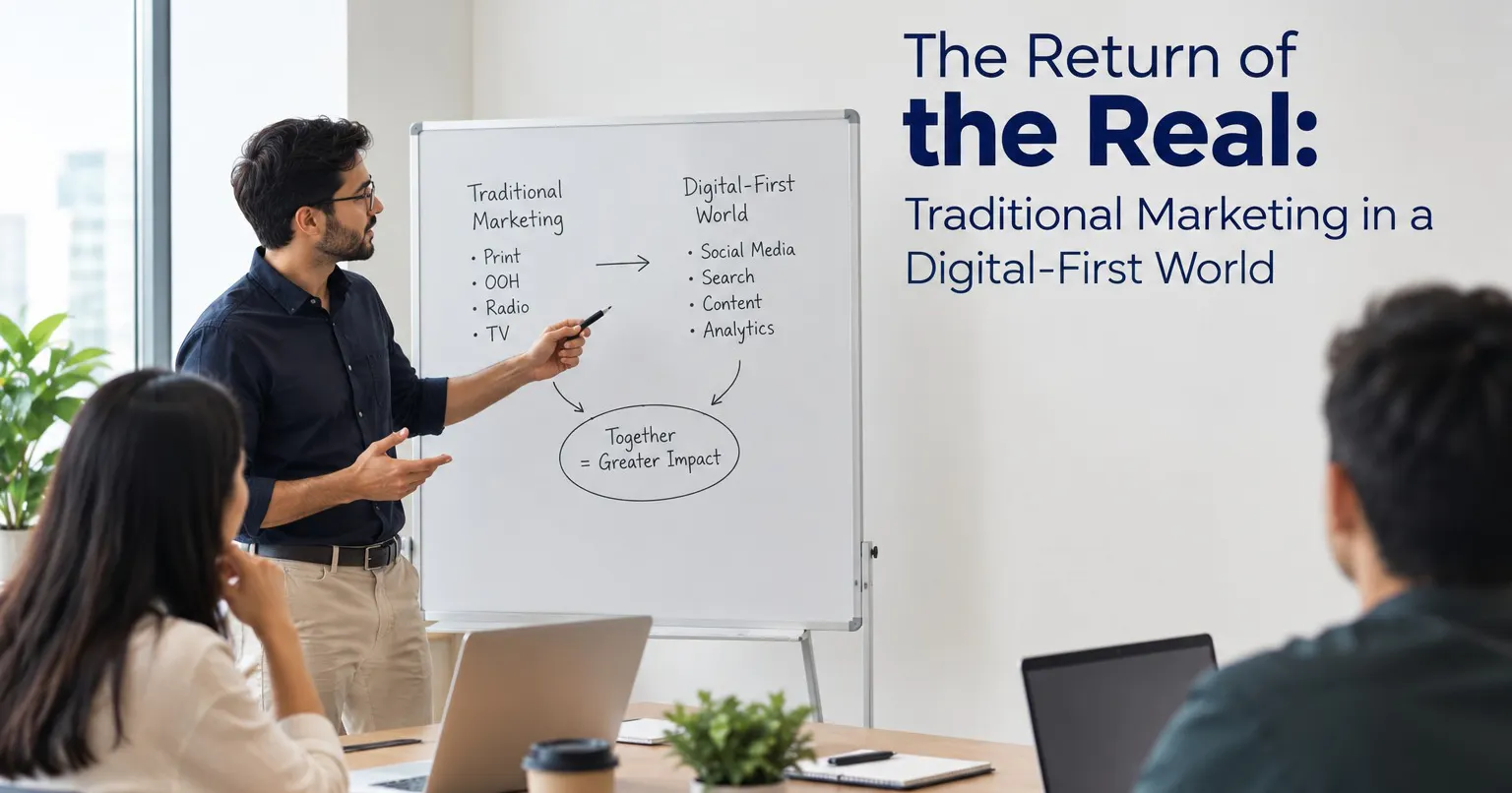

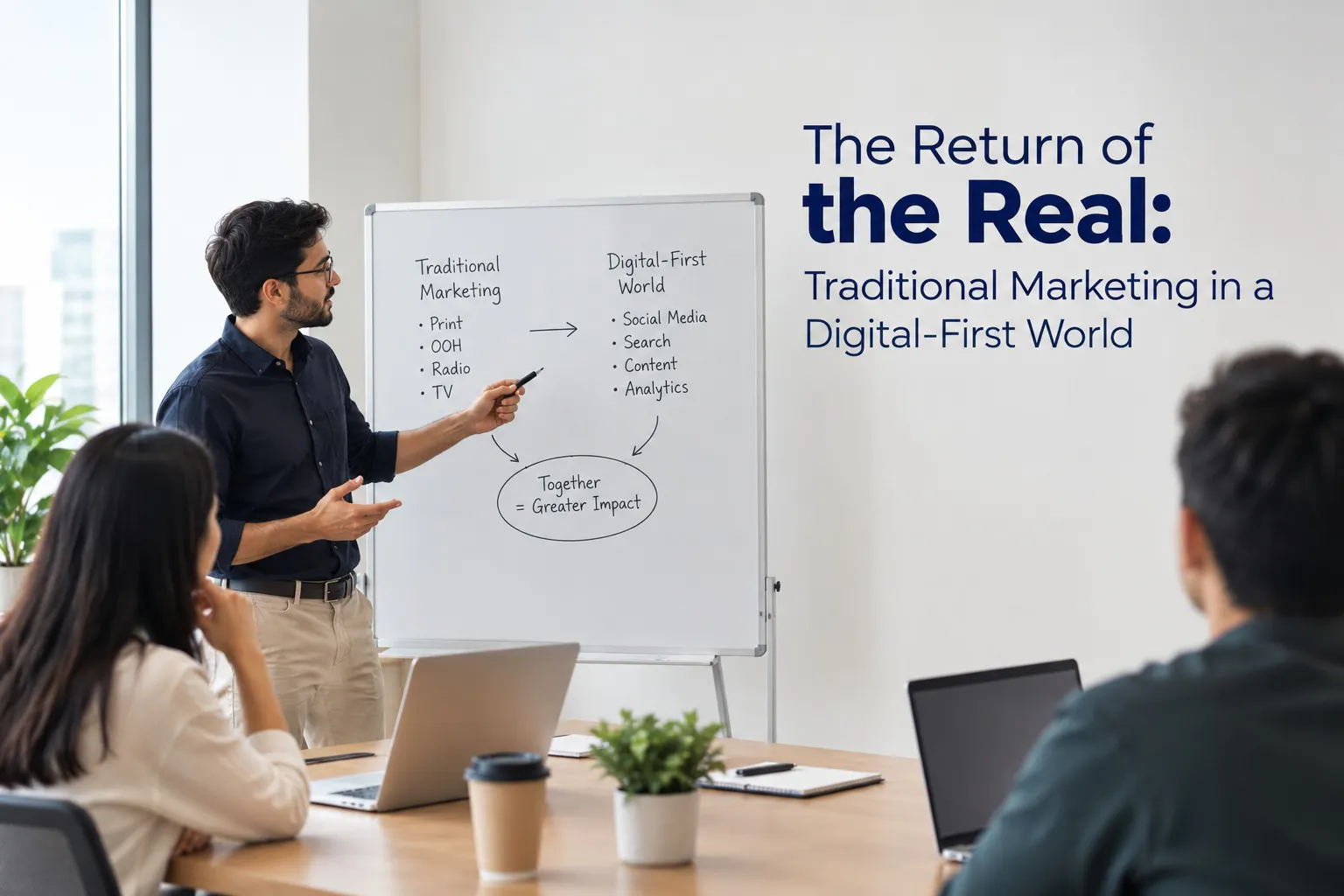
The Return of the Real: Traditional Marketing in a Digital-First World
For nearly a decade, marketing conversations revolved around one axis: digital. Google Ads, SEO, Meta campaigns, influencer tie-ups — if it wasn’t measurable on a dashboard, it barely counted as marketing. Traditional formats — print, out-of-home (OOH), radio, television (to name a few) — were pushed to the margins, treated as relics of a slower, less accountable era. That era is quietly ending.
Entrepreneurs and marketers who spent the past few years chasing click-through rates are beginning to notice what got lost along the way. Not because digital stopped working — it hasn’t, and won’t — but because the world it promised, one of infinite reach at falling cost, has become crowded, expensive and, for many consumers, exhausting.
Joby Thomas Philip, currently a marketing expert with ArthaVerse helping businesses grow their marketing and business development efforts, spent years producing radio advertisements before moving into the events and print media wing of one of India’s largest media houses. He has watched this cycle turn more than once.
“I lived through the shift from radio and print to digital, and I adapted — replacing offline events with webinars, print campaigns with programmatic ads,” he says. “But somewhere in the last couple of years, I started seeing the same brands that pushed everything online asking how to get back into physical spaces.”
When Digital Stopped Being Enough
The pandemic accelerated one particular shift: virtual events. Webinars and virtual launches multiplied because they were location-agnostic, inexpensive, and easy to organise, and much of that habit persists today, for good reason. But over time, businesses and their audiences began noticing what they were missing. A product launch on a screen, however slick, rarely creates the same memory as a room full of people, a live demo, a handshake.
Consumer fatigue with digital advertising is well documented. Research into banner blindness and ad avoidance has repeatedly found that the more digital ads a person encounters, the less attention each one receives, a pattern that has given ad clutter a digital dimension. Nielsen’s Global Trust in Advertising survey, run across dozens of countries over several years, has consistently found that consumers trust television, newspaper, magazine, and billboard advertising more than social media ads, search ads, or online banners, a gap that has held steady across successive editions of the study. When everyone rushed to digital at once, everyone competed for the same shrinking sliver of attention, and the resulting clutter did not help anybody.
That is the real difference between a screen and a hoarding. A hoarding on a highway, or in the departure hall of an airport, does not share its moment with ten other advertisers the way a website homepage does. It gets one or a few uninterrupted seconds in a commuter’s line of sight. A bus-back branding or a mall entrance takeover works on the same principle: one message, one surface, one shot at memory. Compare that with a laptop screen carrying a search results page, open tabs, a notification banner, and an ad competing for the same glance, and it becomes clear why a hoarding, however old-fashioned it may seem, can out-recall a targeted digital impression.
“A digital screen fights for attention with everything else on that screen,” Joby Philip says. “A hoarding doesn’t have that competition. It owns the moment.”
Where Trust Still Lives Offline
None of this is an argument against digital marketing: Performance marketing, SEO, and social media remain indispensable for reach and measurable return on spend, and they are not going anywhere. The smarter conversation today is not digital versus traditional; it is how the two are stitched into one connected system, where an offline moment is promoted digitally, and a digital relationship is deepened offline. This is exactly the thinking behind connected, full-funnel marketing solutions that treat performance campaigns, lead nurturing, and customer loyalty as one system rather than separate line items.
Nowhere is this hybrid more visible than in B2B marketing, where trust, not reach, drives decisions. A CFO evaluating a manufacturing partner rarely converts because of a well-targeted ad. They convert because of a relationship built over a trade show conversation, a referral, a site visit, a handshake at an industry event. Credibility compounds slowly and offline, even when the first point of contact was digital. It is one reason more Indian SMEs are now leaning on structured marketing leadership to think through a long-term strategy that blends digital scale with old-fashioned relationship-building, rather than picking one over the other.
Philip sums up the pattern he keeps seeing: “Brands still want the offline moment — an activation, a launch, a physical experience. What has changed is that the invitation to an offline engagement is now sent entirely through digital channels.” According to him, this hybrid of traditional experiences promoted by digital tools is not going anywhere in the near future.
There is a deeper reason this comeback is not a passing fad. Human beings are social creatures, wired for direct interaction long before they were wired for Wi-Fi. Screen time, however well-designed, cannot fully substitute for shared physical experience, and there are early signs that consumers and marketers alike are beginning to crave breaks from it. As digital fatigue nudges people toward intervening periods of digital detox, the mediums that do not demand a screen — a hoarding, a print spread, a live event — stand to gain disproportionately from that shift.
Nothing beats the recall of a message experienced without a hundred competitors for the same eyeballs. That is the return of the real: not a rejection of digital, but a recognition that a hoarding on a highway, a handshake at an event, or a face in a room can do what a screen cannot. In a digital-first world, this return is not nostalgia — it is simply good marketing strategy, built to last.

