
A company commissions a market research study. The brief is discussed, interviews are conducted, competitors are mapped, and a report arrives. There are charts, customer segments, market estimates and recommendations. The presentation generates a good discussion.
Then everyone returns to work.
The sales team continues pursuing the same accounts. Marketing runs the campaign already on the calendar. The proposed pricing change waits for another meeting. Six months later, someone asks whether the research made any difference.
This is where research loses credibility.
The report may have been technically sound. Its findings may even have been useful. But somewhere between understanding the market and changing what the business does, the connection broke.
At JST Insights, the principle I want our work to be judged by is straightforward: research should help a business make a consequential choice and give it a practical basis for acting on that choice.
That requires more than a well-written report. It requires clarity before the study begins, commercial judgement while interpreting the evidence, and ownership after the presentation ends.
Start with the decision someone has to make
“Help us understand the market” is a reasonable opening request. It is rarely a sufficient research brief.
What does the company need to decide after understanding it?
Whether to enter a category? Which customer group to serve first? Whether a premium price is defensible? Whether weak sales require more advertising or better distribution?
These questions lead to different studies.
Consider a business preparing to introduce an Indian-origin specialty coffee. A broad category report could describe consumption trends, competing brands and the appeal of provenance. All of that provides context. The founder, however, still needs to decide where to launch, what to charge and how much inventory to commit.
The brief becomes more useful when expressed as a choice:
Should we begin with selected cafés, sell directly to consumers, or pursue another channel—and what evidence would justify that choice?
Now the research has a job to do.
Consumer preferences matter, but so do café margins, product consistency, supply capacity and working capital. A channel that attracts interest may be difficult to serve profitably.
Before commissioning a study, I would ask leadership to finish this sentence: “When this research is complete, we must be able to decide…”
If that sentence remains vague, the project needs another conversation before it needs a questionnaire.
Find the cause before prescribing the solution
Businesses naturally describe problems through the symptoms they see.
“Our advertising is not working.”
“Customers are too price-sensitive.”
“Distributors are not pushing the product.”
Each may be true. Each may also be an incomplete explanation.
Take a packaged-food brand with uneven sales across states. The immediate temptation might be to increase advertising in the weaker markets. Yet several different problems could produce the same sales result.
Households may use the category infrequently. They may prefer a familiar local brand. The pack size may exceed what they usually buy. Retailers may stock the product inconsistently. Consumers may want it but fail to find it nearby.
An advertising campaign cannot resolve all these situations.
If availability is the main constraint, additional demand may simply lead to disappointed shoppers. If the category has limited relevance to local eating habits, wider distribution alone may deliver slow-moving stock.
The research must distinguish among these explanations.
That usually means speaking to more than one part of the market. Consumers explain usage and choice. Retailers reveal stock movement and shopper requests. Distributors explain coverage, margins and servicing difficulties. Internal sales data show where the pattern begins.
When these perspectives disagree, the disagreement deserves attention. It may reveal the very issue the business has been overlooking.
The purpose of diagnosis is to identify the constraint that deserves action first.
Treat enthusiasm as a starting point
One of the easiest research findings to overvalue is a positive response to an idea.
People like a product concept. They appreciate a brand story. They say they would consider buying. The presentation feels encouraging.
The commercial questions are harder.
Will they pay the proposed price? What will they stop buying to make room for it? Will they purchase again? Can the business reach them at an affordable cost?
For the coffee example, a distinctive origin story may generate curiosity. Blind product testing can help establish how the coffee performs without that story. Branded testing can then explore what provenance adds to the proposition.
Trade interviews introduce another set of questions. Does the product meet a café’s requirements? Is quality consistent? Are reorder quantities practical? Does the buyer have enough margin?
These are useful checks on an attractive idea.
The same distinction matters in digital healthcare. Someone may welcome the idea of convenient access to care while hesitating to share personal information, complete onboarding or trust an unfamiliar provider.
A favourable concept score does not resolve those barriers.
Research becomes more useful when it examines the effort, cost and uncertainty involved in the next step. Asking whether someone likes a service tells us something. Watching them attempt a relevant task often tells us much more.
Put the economics beside the customer evidence
A recommendation can make sense to customers and still be difficult for the business to sustain.
Lower prices may improve purchase interest while weakening margins. A broader assortment may appeal to buyers while increasing inventory exposure. A new channel may offer volume but require long credit periods and expensive servicing.
These trade-offs belong inside the research discussion.
For a market-entry study, I want to understand how the opportunity changes when the assumptions change. What happens if the achievable price is lower? If repeat orders take longer? If distribution develops more slowly than planned?
A single market-size figure rarely answers these questions.
The distinction between total demand and realistically serviceable demand is especially important for growing businesses. A large national category does not tell a founder how much can be reached with the available team, channel access and cash.
Useful modelling makes those limitations visible.
An EV launch provides a good illustration. Positive attitudes towards electric mobility may indicate interest, but launch planning also needs to account for household usage, charging access, financing, service support and ownership economics.
A promising segment in one geography may be much harder to convert elsewhere.
The resulting recommendation should therefore explain the conditions under which a choice is attractive. Leadership needs to see what must hold true, what remains uncertain and what would cause the business to reconsider.
That is a stronger basis for investment than an impressive forecast presented without its assumptions.
Make the recommendation specific enough to implement
Reports often become vague just when they should become practical.
“Improve customer experience.”
“Strengthen distribution.”
“Build brand awareness.”
These statements identify areas of work. They leave the difficult decisions unresolved.
Which customer experience problem should be fixed? Where should distribution improve? Whose awareness matters, and what should those people understand?
Consider a digital healthcare service that loses users during registration. “Improve onboarding” gives the team little direction. A more actionable recommendation would identify the step causing difficulty, explain the evidence and propose a change to test.
Perhaps users do not understand why particular information is requested. Perhaps they cannot identify a suitable provider. Perhaps the booking process demands too much effort before showing an available appointment.
Each calls for a different intervention.
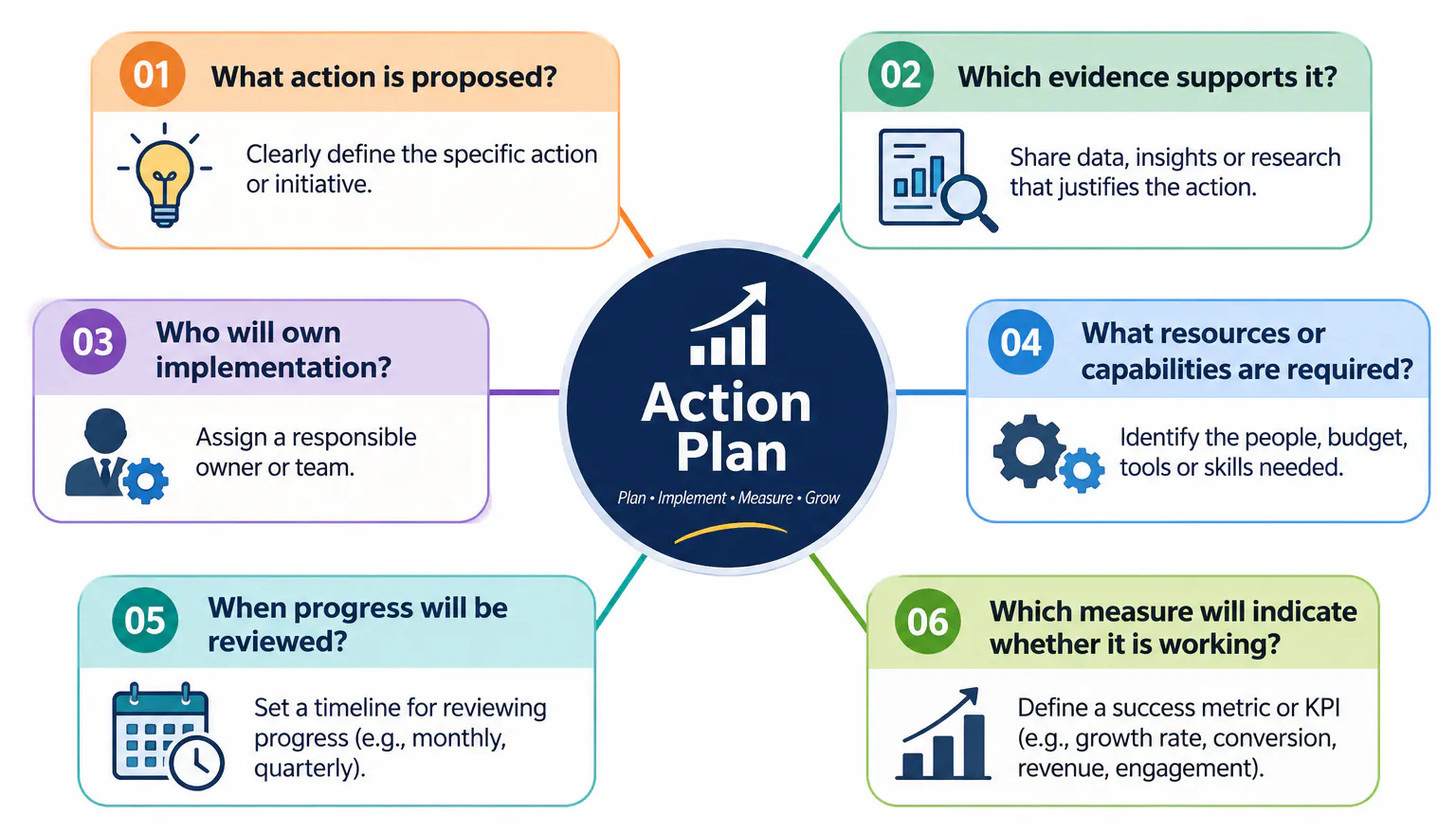
A recommendation should make clear:
· What action is proposed.
· Which evidence supports it.
· Who will own implementation.
· What resources or capabilities are required.
· When progress will be reviewed.
· Which measure will indicate whether it is working.
The owner matters as much as the wording. A recommendation addressed to “the organisation” can remain everyone’s concern and nobody’s responsibility.
Some actions will also depend on others. Marketing may be ready to promote a service while operations cannot yet deliver it reliably. A sensible plan recognises that sequence.
Research should help the business choose an achievable next move.
Give the handover the attention it deserves
The final presentation is often treated as the end of the engagement. For the client, it may be the beginning of the hardest part.
Findings must now compete with existing budgets, departmental priorities and commitments already made. A recommendation that seemed straightforward on a slide can become complicated when teams discuss execution.
This is why I favour an action workshop alongside the research presentation.
The discussion should move beyond whether people agree with the findings. It should establish which choices leadership is making, which actions can begin and which uncertainties need further testing.
For the coffee business, that could mean agreeing on a limited initial channel, the product specification, acceptable commercial terms and the evidence required before expanding.
For a packaged-food brand, it could mean choosing a small number of markets where a particular distribution or pack-price intervention will be tested.
A 30-, 60- or 90-day plan can provide a useful starting structure, provided it reflects the work involved. Some changes can begin immediately. Others require product development, partner agreements or operational preparation.
The important point is to leave with commitments that people understand.
An unresolved decision should be recorded as unresolved, with a clear next step. It should not disappear beneath a broadly worded recommendation that gives the impression of agreement.
Decide how success will be measured before acting
Measurement is much easier when the business establishes a baseline before making changes.
What is happening now? What improvement is expected? Over what period? What else could influence the result?
The relevant measure depends on the original decision.
For a coffee channel pilot, repeat orders, gross margin and supply fill rate may be more informative than initial enquiries. For digital healthcare, completed bookings and continued usage may reveal more than downloads. For an EV launch, qualified enquiries, test drives and conversion can help identify where interest fails to become purchase.
These measures should remain connected to the problem being addressed.
If the intervention aims to reduce registration friction, the first question is whether more suitable users complete registration and reach the intended service. Total revenue may take longer to respond and may be affected by several other factors.
We also need discipline when describing impact.
Sales may rise after a research-led change, but seasonality, promotions, competitor shortages or wider distribution may have contributed. Where feasible, phased rollouts, comparable markets or holdout groups can make the assessment stronger.
The claim should match the evidence.
A credible account of what changed, what was measured and what remains uncertain is more valuable than assigning the entire improvement to research.
Keep the first move proportionate to the evidence
A business does not always need to choose between a full launch and doing nothing.
Often, the sensible next step is a controlled test that answers a specific remaining question.
Can selected cafés reorder consistently at the proposed terms? Does a revised onboarding journey improve completed bookings? Does a different pack size improve retail offtake in the chosen market?
A test is useful when the team knows what it is trying to learn and what decision will follow.
Without those conditions, a pilot can drift. Activity continues, money is spent, and everyone interprets the results differently.
The decision criteria should be agreed beforehand. What would justify expansion? What would require modification? What would suggest stopping?
This also makes room for an outcome that research teams sometimes struggle to communicate: the opportunity may deserve less investment than leadership originally expected.
That can be valuable work.
Avoiding an unsuitable launch, narrowing an overambitious sales plan or postponing expansion until supply is dependable may protect resources that the business needs elsewhere.
Research has to be allowed to change the plan.
What I would ask before commissioning the next study
Before approving a research proposal, I would bring the leadership team back to a few questions.
What decision are we struggling to make? What do we currently believe, and which assumptions could be wrong? What evidence would change our view? Who will act on the findings? How will we assess the result?
These questions do not remove the need for sound methods. They give those methods a clear purpose.
Good interviews, thoughtful sampling, careful analysis and transparent assumptions remain essential. Their value becomes easier to recognise when the work is connected to a decision the business actually faces.
That connection is what I want JST Insights to build: from the management question to the evidence, from the evidence to an achievable action, and from that action to an honest assessment of progress.
When the final report is opened six months later, it should help the team explain the choices it made—and what happened next.

