
Key Takeaways
- Modern marketing data stacks connect scattered tools into one ecosystem, giving teams a unified view of customer behavior, campaign performance, and business outcomes.
- First-party data, AI, and automation are transforming marketing by helping businesses personalize experiences, predict customer actions, and optimize campaigns faster.
- Businesses can build scalable marketing operations by starting with strong data foundations, then adding CRM, automation, analytics, AI, and reporting capabilities.
Marketing teams rely on an ever-expanding technology stack to collect data, understand customer behavior, and execute campaigns. However, what worked in 2023 is no longer enough. Artificial intelligence (AI), stricter privacy regulations, the decline of third-party cookies, and the shift toward first-party data have transformed how marketing teams manage and activate data.
The challenge is that most organizations are adding more tools instead of creating better connected systems. Large marketing teams now use anywhere from 50 to more than 100 marketing tools, with some enterprise organizations managing 91 to 120 tools daily, according to Content Nation. At the same time, only 50 to 60% of purchased martech is actively used, while marketing technology accounts for roughly one quarter of total marketing budgets, according to Empire 365 Marketing.
This is the main reason marketing teams today are drowning in data. Disconnected platforms create data silos, duplicate information, inconsistent reporting, and limited visibility into campaign performance. Modern marketing solutions address this challenge by connecting data collection, integration, analytics, and activation into a unified ecosystem.
In this guide, you'll learn what a modern marketing data stack is, its core components, why it matters in 2026, and how to build a scalable foundation for future marketing success.
What Is a Marketing Data Stack and Why Does It Need to Change?
A marketing data stack is a connected ecosystem of tools that collect, integrate, store, analyze, and activate marketing data across multiple channels. By connecting platforms such as CRM systems, analytics tools, advertising platforms, customer data platforms (CDPs), and marketing automation software, businesses gain a unified view of the customer journey and make faster, data driven decisions.
However, the traditional marketing data stack is no longer enough. Several changes have reshaped how businesses collect and use marketing data:
- Third-party cookies are disappearing, while stricter privacy regulations such as the EU Digital Markets Act (DMA) have reduced cross platform tracking and made traditional attribution less reliable.
- AI-powered search and discovery through platforms like ChatGPT, Gemini, and Perplexity have changed how customers research products, meaning marketers can no longer rely solely on Google Search visibility.
- AI has transformed content creation, making content production faster than ever. The focus has shifted from creating more content to maintaining quality, originality, and consistent brand messaging.
- Marketing teams now manage dozens of disconnected tools, resulting in fragmented data, inconsistent reporting, and limited visibility across the customer journey.
- First-party data has become the foundation of modern marketing, requiring businesses to centralize customer data while improving governance and compliance.
Building Blocks of a Modern Marketing Data Stack
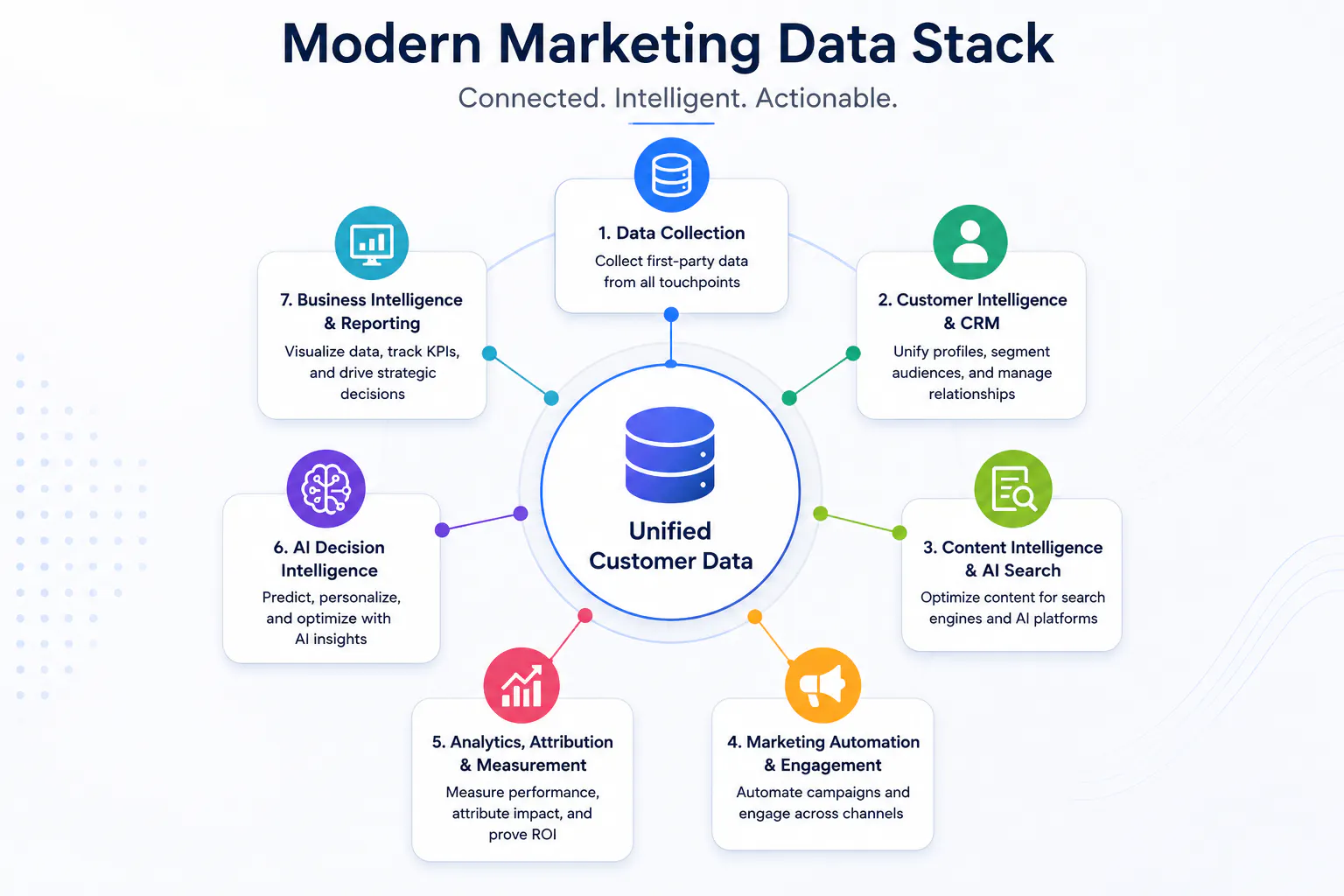
A modern marketing data stack combines multiple capabilities that work together to collect, organize, activate, and analyze marketing data. Each layer performs a specific function while integrating with the rest of the stack to create a connected marketing ecosystem.
1. Customer Data Collection
Customer data collection is the foundation of every marketing data stack. It captures first party data from websites, mobile apps, CRM systems, social media, advertising platforms, ecommerce stores, and offline interactions, giving marketers a complete view of customer behavior.
Key capabilities:
- First-party data collection
- Event tracking
- User behavior monitoring
- Consent and privacy management
- Cross-channel data capture
Common tools: Google Analytics 4, Google Tag Manager, Meta Pixel, LinkedIn Insight Tag, Segment.
2. Customer Intelligence and Relationship Management
Customer intelligence platforms unify customer data from multiple touchpoints into a single profile. They enable audience segmentation, lifecycle management, lead nurturing, and personalized engagement across the customer journey.
Key capabilities:
- Unified customer profiles
- Customer Data Platform (CDP)
- Customer Relationship Management (CRM)
- Audience segmentation
- Lead management
- Customer journey orchestration
Common tools: HubSpot, Salesforce, Microsoft Dynamics 365, Segment, Bloomreach.
3. Content Intelligence and AI Search Optimization
Modern content must be discoverable across both search engines and AI-powered search experiences. Content intelligence platforms help businesses research topics, optimize for search intent, monitor AI visibility, and produce high-quality content at scale.
Key capabilities:
- Search Engine Optimization (SEO)
- Generative Engine Optimization (GEO)
- AI search visibility monitoring
- Content planning
- AI-assisted content creation
- Brand mention tracking
Common tools: Semrush, Ahrefs, ChatGPT, Perplexity, Jasper, Surfer SEO.
4. Marketing Automation and Customer Engagement
Marketing automation platforms coordinate personalized communication across email, social media, paid advertising, messaging apps, websites, and other customer touchpoints to improve engagement throughout the buying journey.
Key capabilities:
- Email automation
- Lead nurturing
- Omnichannel campaign management
- Customer journey
- Conversational marketing
- Personalization
Common tools: HubSpot Marketing Hub, Marketo, Braze, Mailchimp, Klaviyo, WhatsApp Business API.
5. Analytics, Attribution, and Measurement
Analytics platforms transform marketing data into actionable insights by measuring campaign performance, customer journeys, attribution, and business outcomes across every channel.
Key capabilities:
- Marketing analytics
- Multitouch attribution
- Marketing Mix Modeling (MMM)
- Customer journey analytics
- Campaign performance reporting
- ROI measurement
Common tools: Google Analytics 4, Adobe Analytics, Looker Studio.
6. AI Powered Decision Intelligence
Artificial intelligence strengthens every stage of the marketing stack by predicting customer behavior, identifying trends, automating repetitive tasks, and recommending actions that improve marketing performance.
Key capabilities:
- Predictive analytics
- AI driven segmentation
- Lead scoring
- Customer lifetime value prediction
- Campaign optimization
- Personalization recommendations
Common tools: HubSpot AI, Adobe Sensei, Dynamic Yield, Optimizely.
7. Business Intelligence and Reporting
Business intelligence platforms consolidate marketing, sales, and customer data into centralized dashboards, enabling leadership teams to monitor KPIs, evaluate business performance, and make strategic decisions.
Key capabilities:
- Executive dashboards
- Unified reporting
- Cross-channel performance analysis
- KPI monitoring
- Forecasting
- Data governance
Common tools: Power BI, Tableau, Looker
Read more: From Clicks to Conversations
How to Build a Modern Marketing Data Stack?
Most organizations do not need to implement every marketing platform at once. Building your stack in phases helps establish a strong foundation before adding more advanced capabilities.
Phase 1: Build the Data Foundation
Start by collecting accurate first party data and centralizing customer information.
Focus areas:
- Customer data collection
- CRM and Customer Data Platform (CDP)
- Data integration
- Consent management
Common tools:
Google Analytics 4, Google Tag Manager, HubSpot, Salesforce, Segment.
Phase 2: Activate Marketing Channels
Once customer data is unified, connect your marketing channels to deliver personalized experiences across the customer journey.
Focus areas:
- Marketing automation
- Email marketing
- Social media management
- Paid advertising
- Conversational marketing
Common tools:
HubSpot Marketing Hub, Marketo, Mailchimp, Klaviyo, Meta Ads Manager, LinkedIn Campaign Manager, WhatsApp Business API.
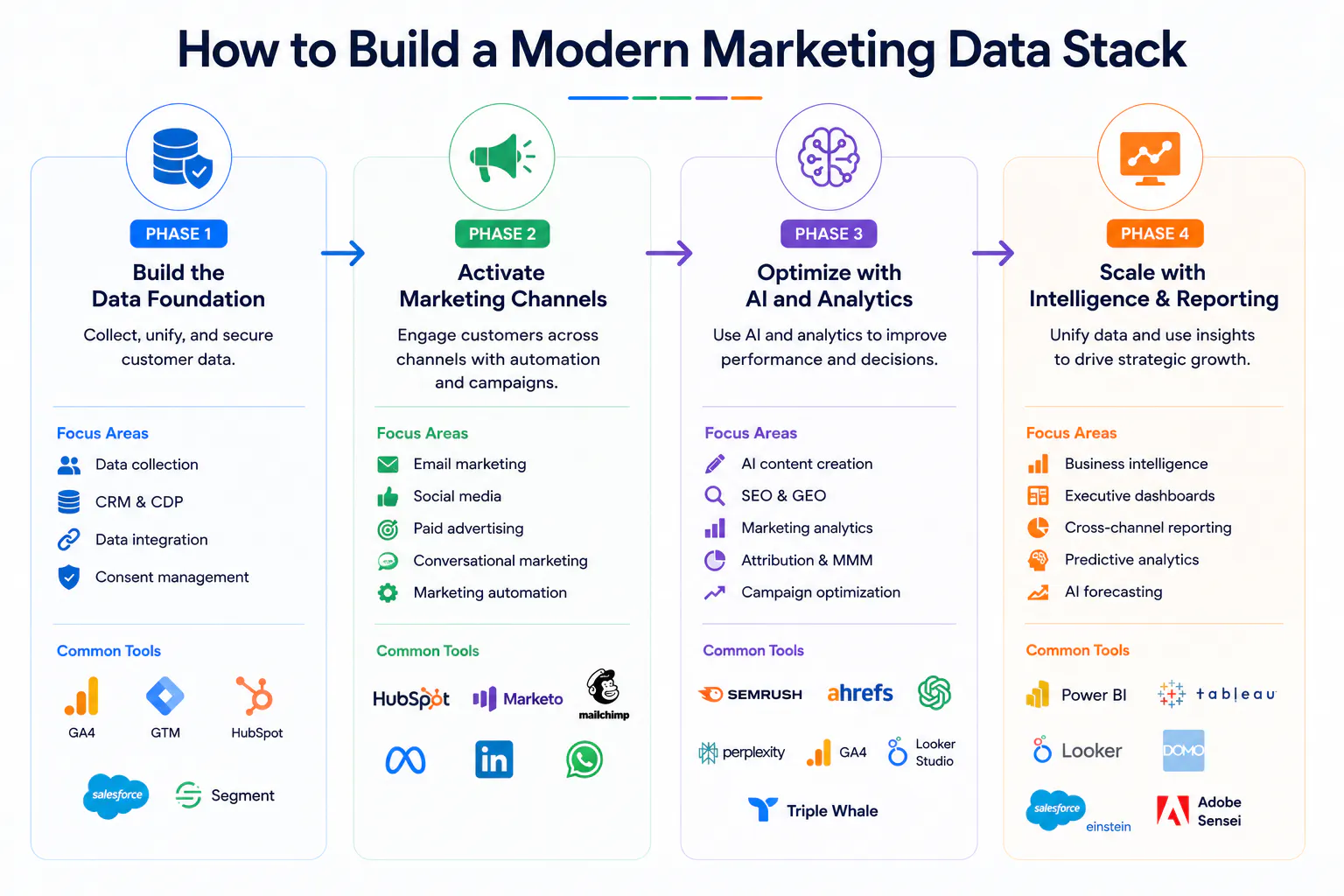
Phase 3: Optimize with AI and Analytics
Use AI and advanced analytics to improve campaign performance, content visibility, and marketing decision-making.
Focus areas:
- AI-powered content creation
- SEO and Generative Engine Optimization (GEO)
- Marketing analytics
- Attribution and Marketing Mix Modeling (MMM)
- Campaign optimization
Common tools:
Semrush, Ahrefs, ChatGPT, Perplexity, Google Analytics 4, Looker Studio, Triple Whale.
Phase 4: Scale with Intelligence and Reporting
As your marketing operations mature, unify data across departments and use business intelligence to guide strategic decisions.
Focus areas:
- Business intelligence
- Executive dashboards
- Cross-channel reporting
- Predictive analytics
- AI-driven forecasting
Common tools:
Power BI, Tableau, Looker, Domo, Salesforce Einstein, Adobe Sensei.
Conclusion
A modern marketing data stack is no longer just a collection of marketing tools. It is a connected ecosystem that unifies customer data, AI, automation, analytics, and reporting to improve marketing performance and business decisions. By building a scalable data foundation and integrating the right technologies, businesses can create personalized customer experiences, optimize campaigns, and drive sustainable growth in an AI-driven, privacy-first marketing landscape.