
Key Takeaways
- A Virtual CMO gives SMEs access to senior marketing expertise without the cost of a full-time CMO, making strategic leadership more accessible and flexible.
- A vCMO can strengthen the entire marketing engine, from strategy and lead generation to marketing ROI, sales alignment, technology, and customer retention.
- The right Virtual CMO should combine strategy with execution, industry experience, measurable results, technology and AI expertise, and the flexibility to scale with the business.
For many small businesses, sustainable growth requires more than running occasional marketing campaigns. It requires strategic planning, consistent execution, and the ability to make informed marketing decisions.
However, hiring a full time Chief Marketing Officer (CMO) is often beyond the budget of most SMEs. According to PayScale, the average salary for a CMO in India is approximately ₹34.75 lakh per year, while Glassdoor estimates an average base salary of around ₹25 lakh annually, with total compensation reaching ₹30 lakh or more. For many small businesses, this represents a significant investment.
This is where the Virtual CMO (vCMO) model comes in. Instead of hiring a full time executive, small businesses can access experienced marketing leadership on a flexible basis to develop growth strategies, improve lead generation, optimize marketing spend, and build a scalable marketing engine at a fraction of the cost. In this guide, we'll explore what a Virtual CMO is, how it works, and why it is becoming a smarter growth model for small businesses.
What Is a Virtual CMO?
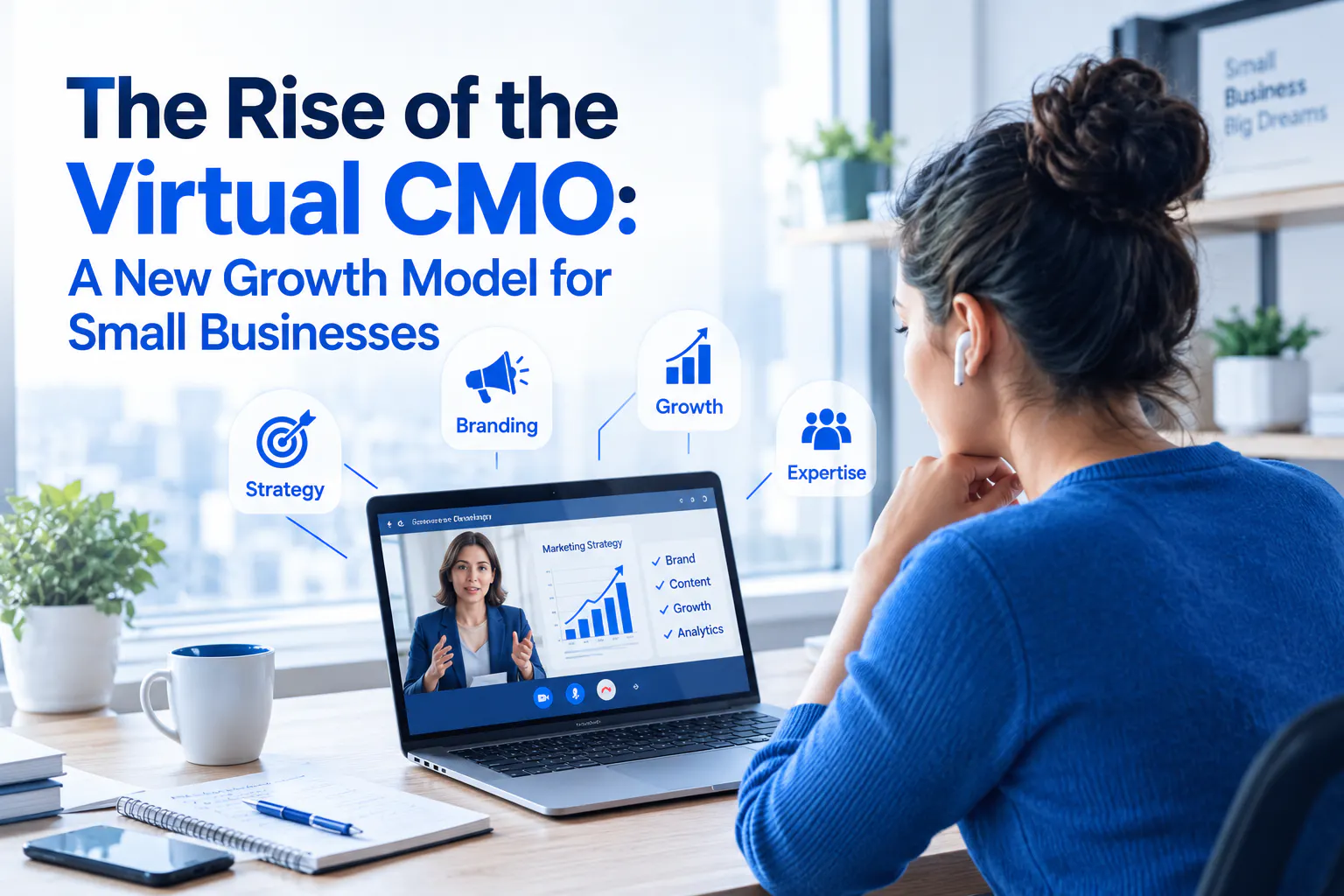
A Virtual Chief Marketing Officer (Virtual CMO or vCMO) is an experienced marketing leader who works with businesses on a part time or contract basis to lead their marketing strategy. Like a traditional CMO, they oversee brand positioning, marketing planning, lead generation, campaign performance, and revenue growth. The key difference is that they provide executive level marketing leadership without the cost and long term commitment of hiring a full time Chief Marketing Officer.
For small businesses and SMEs, a Virtual CMO offers access to senior marketing expertise, helping them build scalable growth strategies, improve marketing ROI, and align marketing with business goals at a much lower cost than a permanent C suite hire.
What Are the Core Responsibilities of a Virtual CMO?
A Virtual CMO is responsible for more than managing marketing campaigns. They provide strategic leadership that helps businesses build a sustainable growth engine. Key responsibilities include:
- Developing the marketing strategy: Create a comprehensive marketing plan aligned with business goals, target audience, and market opportunities.
- Leading brand positioning: Define the brand's messaging, value proposition, and competitive positioning to strengthen market presence.
- Driving lead generation: Build and optimize customer acquisition strategies through SEO, paid advertising, content marketing, email marketing, and other digital channels.
- Managing marketing performance: Monitor key performance indicators (KPIs), analyze campaign results, and optimize marketing investments to improve ROI.
- Aligning sales and marketing: Integrate CRM, lead management, and sales processes to improve lead quality, conversion rates, and revenue growth.
- Implementing marketing technology: Recommend and oversee tools such as CRM platforms, AI solutions, marketing automation, analytics, and customer engagement systems to improve efficiency and scalability.
Virtual CMO vs Fractional CMO: What’s the Difference?
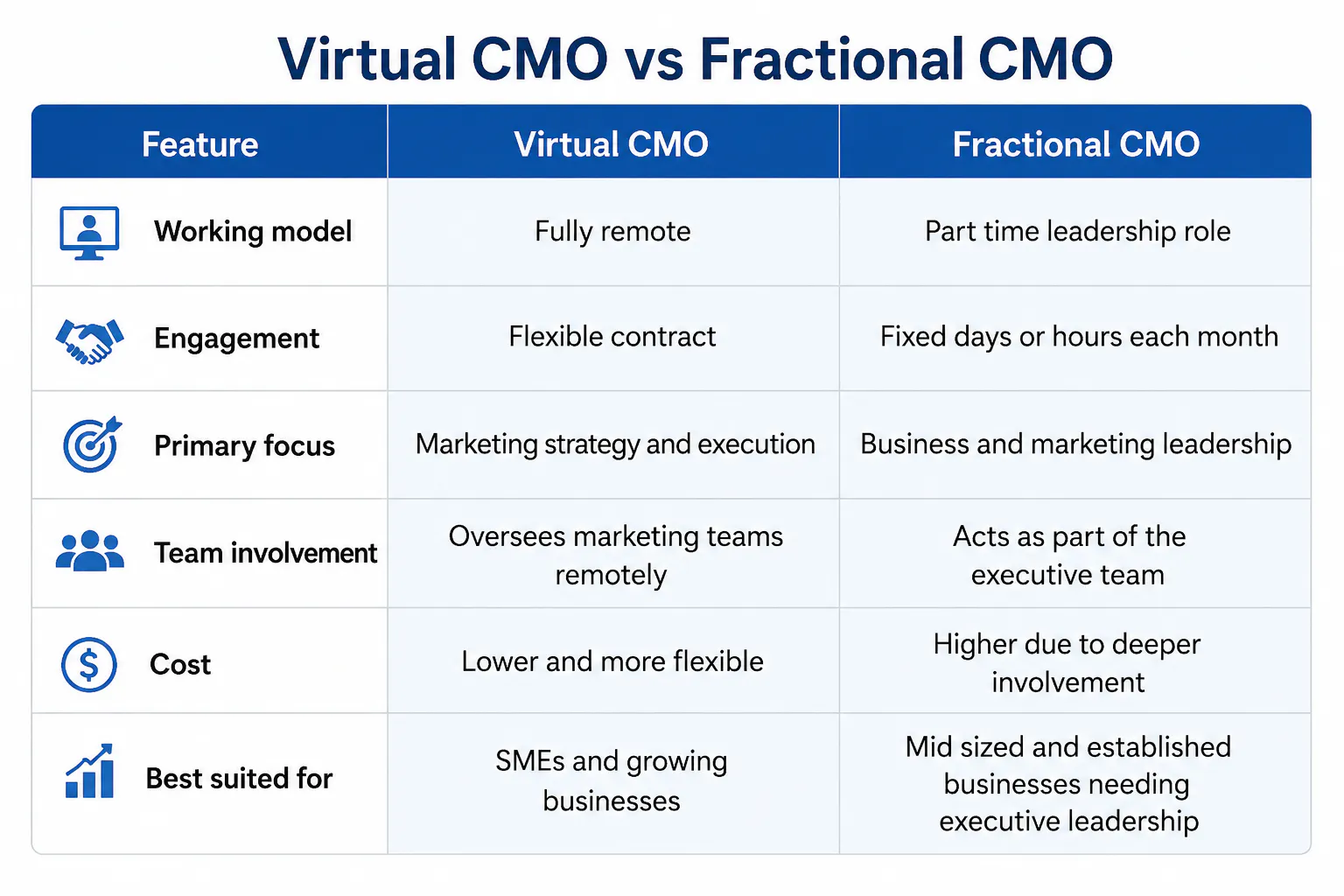
Although the terms Virtual CMO and Fractional CMO are often used interchangeably, they are not exactly the same. Both provide senior marketing leadership without requiring a full time hire, but their working models and level of involvement can differ.
A Virtual CMO primarily works remotely and focuses on building marketing strategies, overseeing campaigns, managing teams, and guiding business growth through digital collaboration. They are ideal for businesses that need ongoing strategic leadership without requiring someone on site.
A Fractional CMO, on the other hand, becomes part of your leadership team for a fixed portion of their time. They typically work a set number of days each week or month, attend executive meetings, and are more deeply involved in company operations and long term business planning.
For most small businesses and SMEs, a Virtual CMO offers greater flexibility and lower costs while still providing the strategic expertise needed to scale marketing efforts.
Which Businesses Need a Virtual CMO?
A Virtual CMO is a practical solution for businesses that need experienced marketing leadership without hiring a full time Chief Marketing Officer. It is particularly valuable for:
- Small and medium sized businesses (SMEs): Need strategic marketing direction, stronger lead generation, and better ROI without the cost of a full time CMO.
- Startups: Require expert guidance to build their brand, launch products, and acquire customers while working with limited budgets.
- Businesses with in house marketing teams: Have marketers in place but need senior leadership to develop strategy, set priorities, and measure performance.
- Businesses experiencing stagnant growth: Struggle with declining leads, low conversion rates, or ineffective marketing campaigns that need a fresh strategic approach.
- Businesses expanding into new markets: Need a go to market strategy, customer insights, and marketing leadership to support business expansion.
- Businesses without a clear marketing strategy: Invest in multiple marketing channels but need someone to align every activity with measurable business goals.
Read more: Why Customer Retention Is More Profitable Than Customer Acquisition?
What Are the Benefits of Hiring a Virtual CMO?
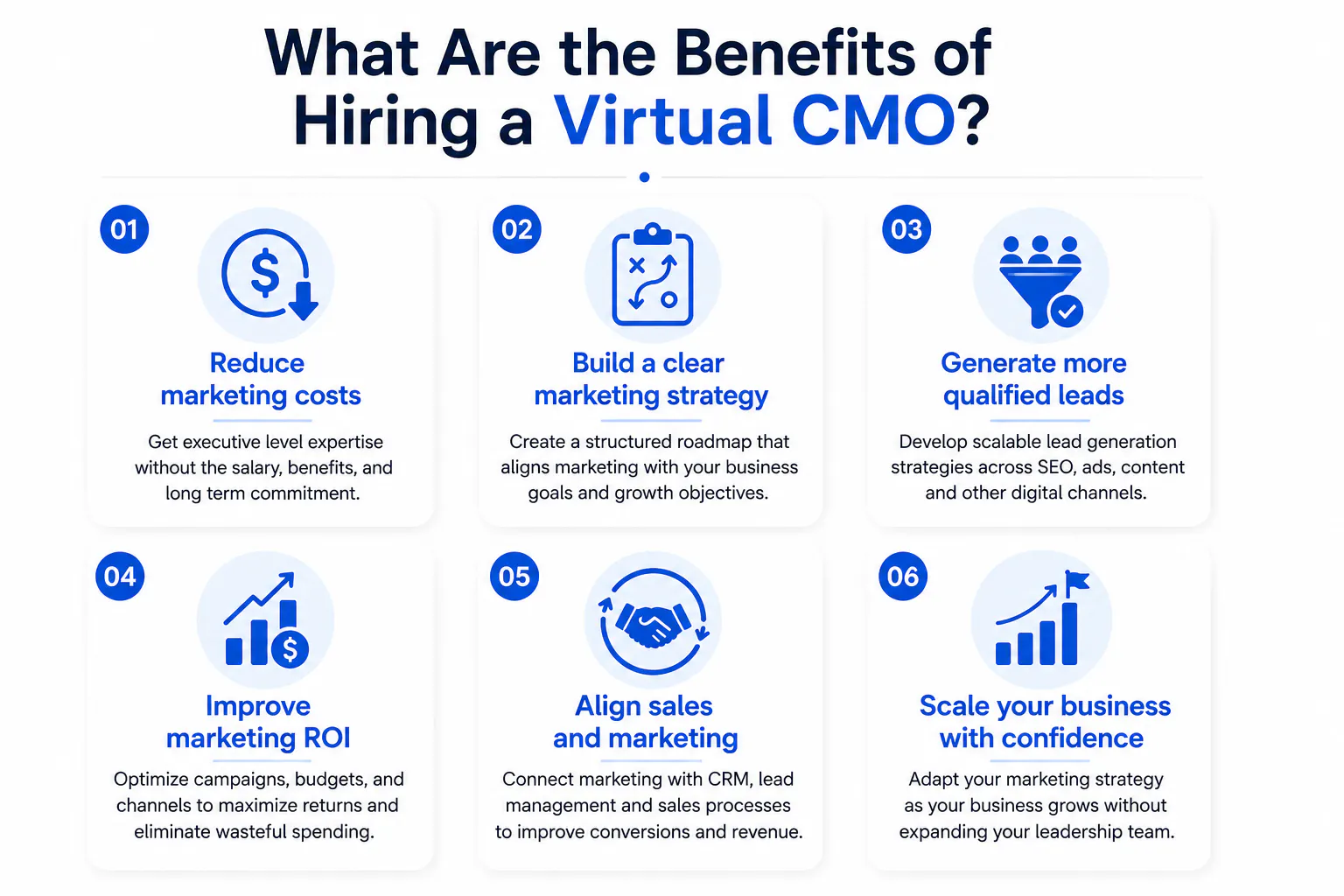
Hiring a Virtual CMO allows businesses to access experienced marketing leadership without the cost of employing a full time Chief Marketing Officer. Here are six key advantages:
- Reduce marketing costs: Gain executive level expertise without the salary, benefits, and long term commitment of a full time CMO.
- Build a clear marketing strategy: Create a structured roadmap that aligns marketing activities with your business goals and growth objectives.
- Generate more qualified leads: Develop scalable lead generation strategies through SEO, paid advertising, content marketing, and other digital channels.
- Improve marketing ROI: Optimize campaigns, budgets, and marketing channels to maximize returns and eliminate unnecessary spending.
- Align sales and marketing: Connect marketing initiatives with CRM systems, lead management, and sales processes to improve conversions and revenue.
- Scale your business with confidence: Adapt your marketing strategy as your business grows without immediately expanding your leadership team.
What Should You Consider Before Hiring a Virtual CMO?
Choosing the right Virtual CMO can have a significant impact on your business growth. Before making a decision, consider the following factors:
- Relevant industry experience: Look for someone who understands your industry, target audience, and competitive landscape.
- Proven track record: Review past results, case studies, or client success stories to assess their ability to deliver measurable outcomes.
- Strategic and execution capabilities: Ensure they can develop marketing strategies while also guiding implementation and measuring performance.
- Technology and AI expertise: Choose a Virtual CMO who is familiar with CRM platforms, marketing automation, AI tools, analytics, and modern digital marketing technologies.
- Communication and collaboration: They should work closely with your internal team, provide regular updates, and align marketing efforts with your business objectives.
- Scalability and flexibility: Select a Virtual CMO whose engagement model can adapt as your business grows and your marketing needs evolve.
Read more: Why Businesses Are Moving From Marketing Vendors to Growth Ecosystems?
How Does ArthaVerse Help Businesses Scale Without a Full-Time CMO?
ArthaVerse provides SMEs with the tools and solutions needed to build, manage, and optimize their marketing efforts without the cost of hiring a full time Chief Marketing Officer.
- Performance Marketing: Generate qualified leads through targeted campaigns across search engines and social media.
- ArthaGPT: Engage website visitors instantly, answer enquiries, qualify leads, and provide 24/7 AI powered customer interactions.
- CRM and Lead Management: Centralize leads, track customer interactions, manage sales pipelines, and improve conversion rates.
- WhatsApp Based Loyalty Programs: Strengthen customer relationships with personalized messaging, rewards, automated follow ups, and repeat engagement.
- Integrated Marketing Ecosystem: Connect marketing, sales, customer engagement, and retention into one streamlined platform, helping SMEs execute growth strategies more efficiently.
Conclusion
A Virtual CMO gives small businesses and SMEs access to experienced marketing leadership without the cost and long-term commitment of hiring a full-time CMO. From developing a clear marketing strategy and generating qualified leads to improving marketing ROI, aligning sales and marketing, and guiding technology decisions, a vCMO can help businesses build a more structured and scalable approach to growth.
For businesses facing stagnant growth, limited marketing expertise, or the need to expand into new markets, a Virtual CMO can provide the strategic direction and flexibility needed to make better marketing decisions and support long-term business growth.