
Key Takeaways
- WhatsApp gives restaurants a direct channel to promote offers, manage orders, and stay connected with customers.
- Restaurants can use WhatsApp for ordering, reservations, loyalty programs, personalised promotions, re-engagement, and customer feedback.
- A WhatsApp-based loyalty program can help restaurants increase repeat purchases by connecting customer activity, rewards, and personalised engagement.
WhatsApp marketing gives restaurants and food businesses a direct channel to reach customers, promote offers, increase orders, and encourage repeat visits. WhatsApp messages can achieve 85%+ open rates, compared with around 20% to 25% for email, while reported WhatsApp click or conversion rates can reach 45% to 60%, compared with roughly 2% to 5% for email.
In this blog, you will learn how WhatsApp marketing works for restaurants, which campaigns can increase orders, how to use WhatsApp for customer retention, and how restaurants can turn existing customers into repeat buyers.
Why WhatsApp For Restaurants?
WhatsApp has an open rate of more than 85%, compared with around 20% to 25% for email. This gives restaurants a direct channel for reaching customers with promotions, order updates, reservations, loyalty rewards, and other time sensitive messages.
The difference becomes clearer across key marketing metrics:
- 85%+ open rate: WhatsApp, compared with 20% to 25% for email.
- 45% to 60% conversion rate: WhatsApp, compared with 2% to 5% for email.
- 50% customer preference: WhatsApp for order and delivery updates.
- 23% customer preference: WhatsApp for promotional messages.
- 90 second response time: WhatsApp, compared with around 90 minutes for email.
For restaurants, these numbers make WhatsApp relevant beyond promotions. The channel supports customer communication across orders, reservations, offers, feedback, and repeat purchases.
Read more: WhatsApp Loyalty Programs vs Traditional Loyalty Apps
What Are the Seven Best WhatsApp Marketing Strategies For Restaurants And Food Brands?
The seven best WhatsApp marketing strategies for restaurants and food brands are direct ordering, reservation management, loyalty programs, personalised promotions, abandoned order recovery, customer re engagement, and post purchase communication. Together, these strategies connect WhatsApp with acquisition, conversion, customer experience, and repeat purchases.
1. Take Direct Orders Through WhatsApp
Use WhatsApp to make ordering faster and more convenient. Customers can browse products, select items, confirm quantities, provide delivery details, and receive order updates within the same conversation.
For F&B brands, this also creates a direct customer relationship instead of relying entirely on third party ordering platforms.
2. Manage Reservations And Bookings
Let customers enquire about availability, book tables, confirm their reservation, or request changes directly through WhatsApp.
Automated confirmations and reminders can reduce the back and forth while making the booking experience more convenient.
3. Build A WhatsApp Loyalty Programme
Use a WhatsApp loyalty program to keep customers engaged beyond each purchase. Customers can receive points updates, unlock rewards, get personalised offers, and receive reminders when they are close to their next reward.
The biggest advantage is that customers do not need another app to participate.
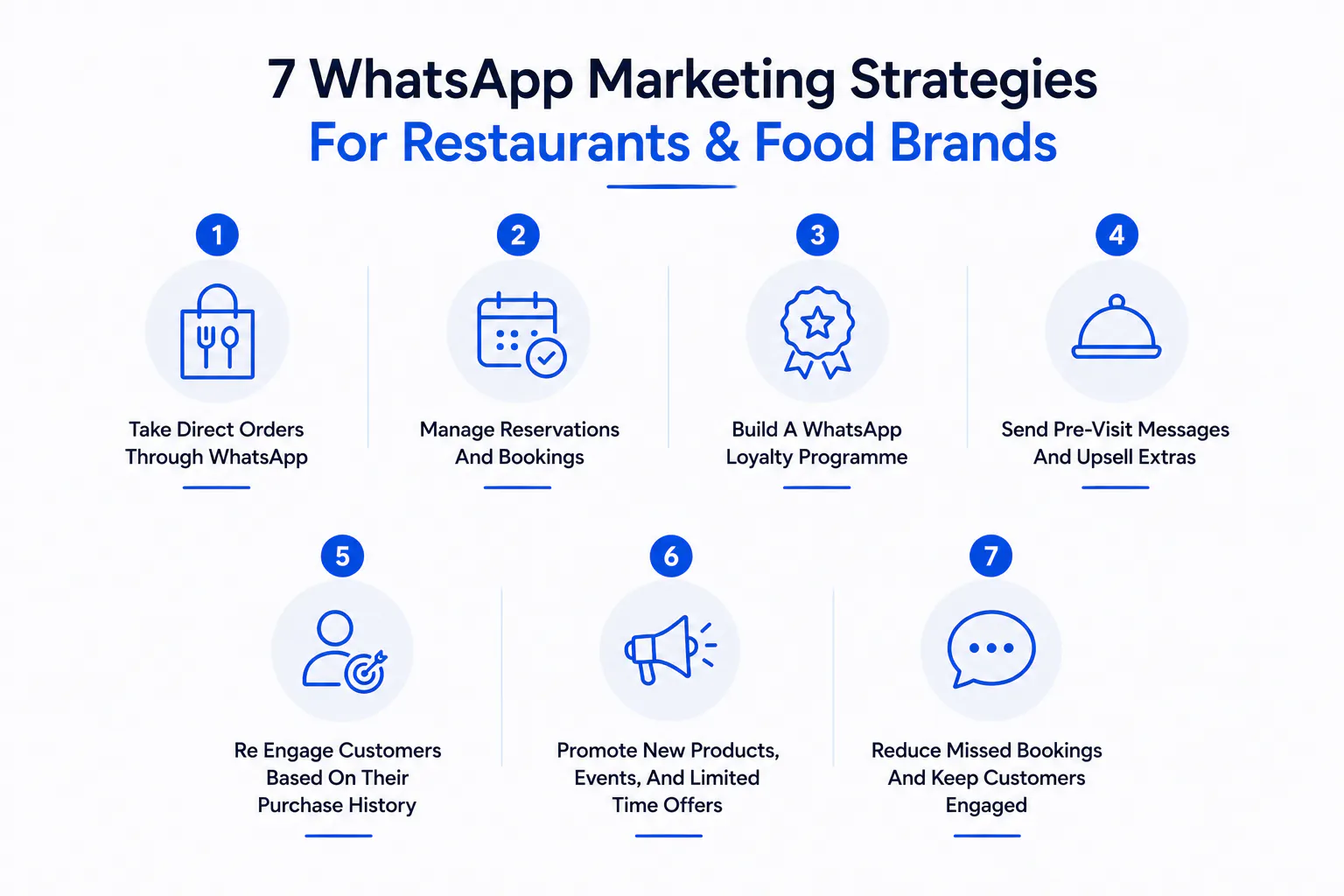
4. Send Pre Visit Messages And Upsell Relevant Extras
A confirmed reservation creates a valuable opportunity before the customer arrives. Send a timely WhatsApp message offering relevant extras such as a welcome drink, wine pairing, tasting menu upgrade, birthday arrangement, or special dessert.
Keep the choice limited to one or two options and make acceptance simple.
For example:
“Celebrating something special? We can arrange a dessert and table setup for your visit. Reply YES to add it to your reservation.”
Read more: 10 Customer Loyalty Program Examples From Top Indian Retail Brands
5. Re Engage Customers Based On Their Purchase History
Instead of sending the same promotion to everyone, use previous purchases to make messages more relevant.
- Send product reminders based on previous orders.
- Recommend products similar to previous purchases.
- Offer relevant incentives to customers who have become inactive.
- Notify customers when a previously purchased product is available again.
- Create different messages for frequent and occasional customers.
A customer who regularly orders a particular product could receive a timely reminder, while an inactive customer could receive a personalised reason to return.
6. Promote New Products, Events, And Limited Time Offers
WhatsApp works well for time sensitive campaigns because messages reach customers directly.
Restaurants can use WhatsApp to announce:
- New menu items
- Seasonal menus
- Limited time dishes
- Special events
- Festive offers
- Weekend promotions
- Limited availability
- Exclusive loyalty member offers
The important part is to give every message one clear reason to act rather than filling the conversation with multiple promotions.
Read more: Loyalty Points vs Cashback vs Rewards: Which Drives Retention?
7. Reduce Missed Bookings And Keep Customers Engaged
Use WhatsApp to confirm upcoming reservations, send reminders, provide directions or important visit information, and make it easy for customers to reschedule.
After the visit, the same channel can be used for:
- Feedback requests
- Thank you messages
- Loyalty updates
- Relevant recommendations
- Reorder reminders
- Future offers
This allows restaurants to continue the relationship after the customer has left rather than treating the reservation as the end of the customer journey.
10 Ready To Use WhatsApp Marketing Templates For F&B Brands
These templates cover the key stages of the customer journey, from the first order to repeat purchases, loyalty, and retention. Replace the variables in [square brackets] with your customer or campaign details.
1. Order Confirmation
“Hi [first name], your order #[order number] is confirmed! We’re preparing your [items]. Expected delivery: [delivery time].”
2. Reorder Reminder
“Hi [first name], running low on [product name]? It may be time for your next order. Reply to REORDER and we’ll get it started.”
3. New Product Launch
“Something new is here! Meet [product name], now available at [brand name]. Want to be one of the first to try it? Reply YES.”
4. Personalised Recommendation
“Since you enjoyed [previous product], you might like [recommended product]. Want to give it a try? Reply TRY.”
5. Loyalty Programme Welcome
“Welcome to [brand name] Rewards, [first name]! You’ll now earn points with every purchase. Your current balance is [points] points.”
6. Loyalty Reward Unlocked
“You’ve unlocked a reward! You can now claim [reward name]. Use your reward before [expiry date].”
7. Loyalty Milestone Reminder
“You’re just [points remaining] points away from your next [reward]. One more purchase could get you there!”
8. Exclusive Loyalty Offer
“Because you’re one of our valued customers, here’s an exclusive offer: [offer]. Available until [expiry date]. Reply to CLAIM to use it.”
9. Win Back Message
“We haven’t seen you in a while, [first name]. Come back to [brand name] and enjoy [offer]. Your next favourite could be waiting: [order link].”
10. Feedback Request
“Hi [first name], how was your experience with [brand name]? Rate your experience from 1 to 5. Your feedback helps us serve you better.”
Read more: Are Loyalty Programs Worth It?
How Can ArthaVerse Help Restaurants Build Customer Loyalty?
ArthaVerse’s WhatsApp based loyalty program allows F&B businesses to connect customer enrollment, purchases, rewards, and engagement through WhatsApp.
Restaurants can use the platform to:
- Enroll customers through QR codes: Customers can join the loyalty program without downloading a separate application.
- Track customer purchases: Businesses can build a record of customer purchase activity and frequency.
- Send loyalty rewards: Customers can receive points, rewards, and milestone notifications through WhatsApp.
- Create personalised engagement: Businesses can use customer purchase behaviour to send more relevant offers and recommendations.
- Re-engage inactive customers: Restaurants can identify customers who have stopped purchasing and send targeted win back messages.
- Monitor loyalty performance: Businesses can track purchase frequency, redemption, repeat purchases, customer activity, and other loyalty metrics.
Conclusion
WhatsApp can help restaurants turn everyday customer interactions into opportunities for more orders, repeat visits, and stronger customer loyalty. From direct ordering and reservation reminders to personalised promotions, loyalty rewards, and win back campaigns, businesses can use the channel across the entire customer journey.
The key is to make every message useful and relevant. Customers should receive the right communication based on what they purchased, when they purchased, and what they are likely to need next.