

Key Takeaways:
- Fragmented lead management can cause delayed responses, missed follow ups, duplicate work, and lost revenue opportunities.
- A single revenue system connects marketing, sales, CRM, AI, WhatsApp, and customer data to create a unified customer journey.
- Connecting existing systems helps businesses improve conversions, customer experience, efficiency, and long term revenue growth.

Every business wants more leads, but managing them becomes harder as marketing expands across Google Ads, Meta, SEO, LinkedIn, WhatsApp, referrals, marketplaces, and websites. Enquiries often end up scattered across platforms, spreadsheets, inboxes, and CRM tools instead of one connected pipeline.
The impact is measurable. HubSpot reports that 33% of marketers struggle with measuring marketing ROI and 27.6% cite sales and marketing misalignment as a major challenge.
The problem is not having multiple channels. It is failing to connect the leads, customer data, sales activity, and follow ups they generate.
In this guide, you'll learn how fragmented lead management affects growth and how a connected system can improve productivity, conversions, and revenue.
What Is Fragmented Marketing?
Fragmented marketing is a business approach where marketing, sales, customer engagement, and customer data operate across separate tools, teams, or vendors without working together. Each function focuses on its own objectives and reporting, making it difficult to create a connected customer journey or measure the true impact on revenue.
For example, a customer might discover your business through Google Search, click a paid advertisement, chat with an AI agent, and later contact your sales team through WhatsApp. If these interactions are stored in different systems, your business loses valuable customer insights, marketing becomes less effective, and opportunities to convert or retain customers are often missed.
Instead of managing disconnected channels, businesses are increasingly adopting integrated revenue systems that connect every customer interaction from lead generation to long term retention.
Why Lead Management Has Become More Complex?
Today's customer journey is no longer linear. A prospect may discover your business through Google, click a Meta ad, enquire on WhatsApp, visit your website, download a brochure, and finally speak with your sales team. While this creates more opportunities to generate leads, it also makes managing those interactions far more complex. Without a connected system, businesses struggle to keep customer information organized, resulting in operational inefficiencies and missed sales opportunities.
- Customers interact across multiple touchpoints: Buyers engage through websites, social media, search engines, WhatsApp, email, phone calls, and marketplaces before making a purchase.
- Businesses use multiple marketing and sales platforms: Different tools are often used for advertising, CRM, email marketing, customer support, analytics, and communication, creating disconnected workflows.
- Teams struggle to maintain one customer view: Customer information becomes scattered across different platforms, making it difficult to understand the complete buying journey.
- Manual processes slow business operations: Switching between systems, updating records, assigning leads, and tracking follow ups manually consumes valuable time and increases the risk of errors.
Read more: The Modern Marketing Stack Every Indian Business Needs in 2026
The Hidden Costs of Fragmented Lead Management
Every new lead represents potential revenue, but only if it is managed efficiently. As businesses adopt more channels to generate enquiries, they often create disconnected systems where marketing, sales, customer support, and communication operate independently. The result isn't just operational complexity. It directly impacts revenue, customer experience, and business performance.
Delayed lead response
Customers expect immediate engagement, yet many businesses struggle to respond quickly because enquiries arrive across websites, Meta Ads, Google Ads, WhatsApp, email, LinkedIn, phone calls, and marketplaces. Sales teams often spend valuable time identifying where a lead originated, reviewing previous conversations, and assigning ownership before making first contact.
Research from LeadResponse found that only 37% of businesses respond to new enquiries within the first hour, even though response speed is strongly linked to conversion rates. Every delay increases the likelihood of losing qualified prospects to faster competitors.
Revenue leakage through missed follow ups
Lead generation requires significant investment, but many businesses fail to maximize that investment because enquiries aren't nurtured consistently after the first interaction. Follow ups depend on manual reminders, spreadsheets, or individual sales representatives, making it easy for promising opportunities to disappear from the pipeline.
LeadResponse reports that 71% of internet generated leads are lost because of poor follow up, while 44% of sales representatives never contact a lead after the initial interaction. Instead of generating more leads, many businesses first need to stop losing the ones they already have.
Fragmented customer intelligence
Customer information is often scattered across CRM platforms, email systems, WhatsApp conversations, spreadsheets, marketing software, and customer support tools. Each platform contains only part of the customer journey, making it difficult to understand buying behaviour or previous interactions.
Without a unified customer profile, sales teams lack the context needed to personalize conversations, recommend relevant solutions, or accurately identify purchase intent.
Read more: What Is a Unified Customer Intelligence Layer and How Does It Work?
Rising operational inefficiency
Managing disconnected platforms creates significant operational overhead. Employees repeatedly enter customer information, switch between applications, search for previous conversations, update spreadsheets, and coordinate internally before progressing a lead.
As lead volumes increase, these repetitive administrative activities consume more time than actual customer engagement, reducing productivity across both marketing and sales teams.
Inconsistent customer experiences
Modern buyers expect businesses to recognize them regardless of which channel they use. However, fragmented systems often result in customers repeating the same information multiple times, receiving duplicate communication, or being contacted by different representatives without context.
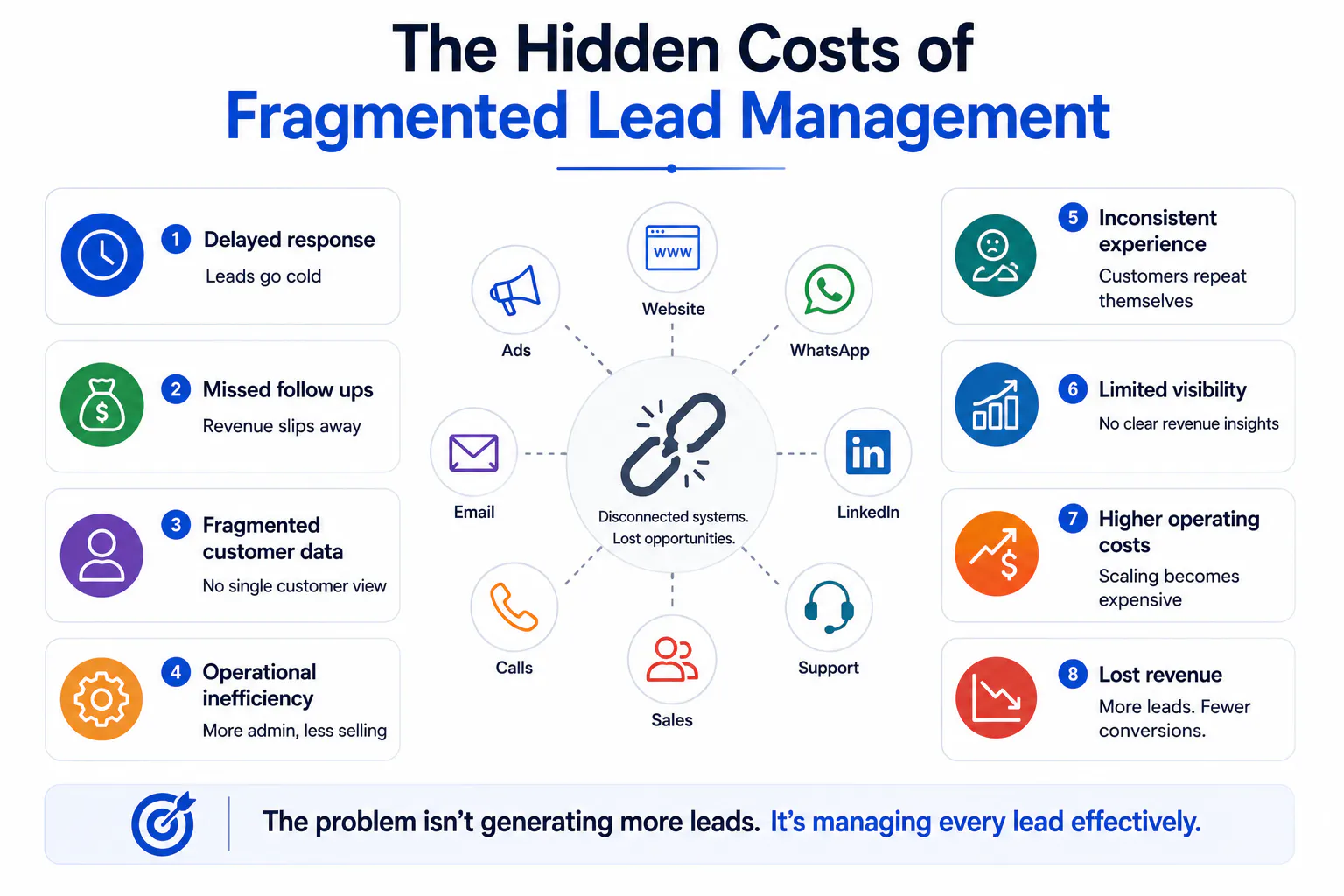
Limited visibility into business performance
Disconnected systems make it difficult for leadership teams to understand what is actually driving revenue. Marketing reports, CRM data, sales performance, and customer interactions exist across multiple platforms, making accurate reporting both time consuming and incomplete.
Without centralized visibility, businesses struggle to answer critical questions such as:
- Which channels generate the highest quality leads?
- Where are prospects dropping out of the sales funnel?
- How long does it take to convert an enquiry into a customer?
- Which campaigns generate the highest revenue rather than just the most leads?
Higher operational costs as the business scales
Growth often leads businesses to add more software subscriptions and hire additional staff to manage increasing lead volumes. Unfortunately, disconnected systems simply multiply complexity rather than improving efficiency.
Instead of creating a scalable operating model, businesses spend more on administration, software, manual coordination, and reporting while customer acquisition costs continue to rise.
Lost revenue despite generating more leads
Perhaps the biggest hidden cost is that businesses often assume they have a lead generation problem when they actually have a lead management problem. LeadResponse found that 78% of businesses lose potential customers because they lack proper lead tracking, while only 27% of leads are ever contacted. This means marketing may already be generating enough opportunities, but fragmented operations prevent those opportunities from becoming revenue.
The businesses that grow fastest are not always the ones generating the most leads. They are the ones with systems that ensure every lead is tracked, qualified, nurtured, and converted efficiently.
Read more: From Clicks to Conversations
The Solution: Building a Single Revenue System
A single revenue system connects marketing, sales, customer engagement, automation, and customer intelligence into one integrated ecosystem. Instead of managing disconnected tools and teams, businesses create a unified customer journey where every interaction contributes to revenue growth.
Benefits of Building a Single Revenue System
- One customer view across every channel: Customer interactions from websites, CRM, AI agents, WhatsApp, email, and advertising platforms are connected into one centralized profile, providing complete visibility throughout the customer journey.
- Faster lead response: Automated lead capture, qualification, and routing ensure enquiries reach the right team quickly, reducing response times and increasing conversion opportunities.
- Improved customer experience: Every touchpoint is connected, allowing businesses to deliver consistent communication, personalized interactions, and seamless customer journeys.
- Higher conversion rates: AI powered engagement, centralized lead management, and automated follow ups help convert more enquiries into paying customers.
- Better ROI measurement: Businesses can track the complete customer journey and understand which activities contribute directly to revenue instead of measuring isolated marketing metrics.
- Reduced software complexity: A connected ecosystem replaces multiple disconnected tools, simplifying operations and reducing administrative overhead.
- Increased customer lifetime value: Personalized engagement, loyalty programs, and ongoing customer communication encourage repeat purchases and strengthen long term relationships.
- Easier business scaling: Businesses can introduce new channels, technologies, and campaigns without creating additional operational complexity.
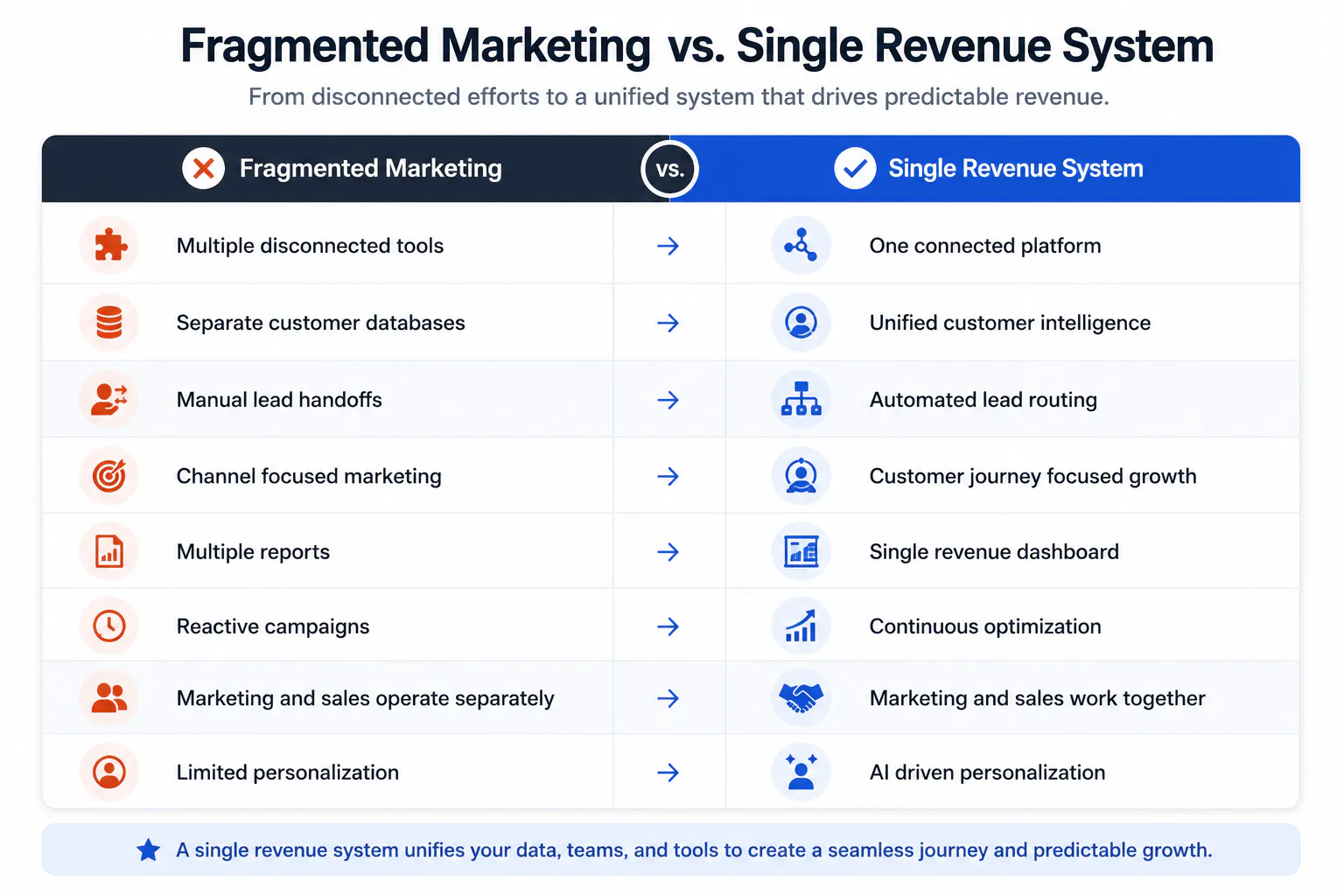
Fragmented Marketing vs a Single Revenue System
Fragmented marketing often creates disconnected customer experiences and operational inefficiencies, while a single revenue system connects every stage of the customer journey into one integrated ecosystem.
How to Transition From Fragmented Marketing to a Single Revenue System?
Building a single revenue system is a gradual process. By connecting your existing tools, teams, and customer data, businesses can create a more efficient and scalable growth engine.
- Audit your current technology stack: Review your existing software, agencies, and marketing tools to identify disconnected systems, duplicate processes, and operational gaps.
- Centralize customer data: Bring customer information from websites, CRM, marketing platforms, AI agents, and communication channels into one centralized system to create a complete customer profile.
- Connect marketing and sales: Align both teams through shared customer data, standardized lead management, and common business objectives to improve collaboration and conversions.
- Introduce AI driven automation: Automate lead qualification, follow ups, appointment scheduling, and repetitive customer interactions to improve efficiency and reduce manual work.
- Build a unified customer journey: Connect every touchpoint from lead generation to customer retention, ensuring customers receive a consistent experience throughout their relationship with your business.
- Measure revenue instead of channel metrics: Focus on qualified leads, conversions, customer lifetime value, and revenue growth rather than isolated metrics such as clicks, impressions, or website traffic.
Read more: Seven Proven Customer Loyalty Strategies to Increase Retention
How ArthaVerse Helps Businesses Build a Single Revenue System?
ArthaVerse combines the essential technologies businesses need to attract, convert, retain, and grow customers through one connected business ecosystem. This makes ArthaVerse’s platform or offerings not only end-to-end but also a one-stop shop for SMEs and businesses looking to accelerate growth by fixing gaps in their marketing and sales funnels.
- Performance marketing: Generates qualified traffic through SEO, paid advertising, and digital campaigns that support sustainable customer acquisition.
- AI agents: Engage website visitors instantly, answer enquiries, qualify leads, and provide 24/7 conversational support across the customer journey.
- CRM and lead management: Centralizes customer information, manages sales pipelines, and tracks every lead from first enquiry to conversion.
- Customer intelligence: Connects data from marketing, sales, CRM, AI agents, and customer interactions to create a unified customer view for better decision making.
- WhatsApp-based loyalty programs: Builds stronger customer relationships through personalized messaging, loyalty rewards, referral campaigns, and automated retention initiatives that encourage repeat business.
Conclusion
Fragmented marketing does not necessarily mean a business needs more leads. Often, it needs a better way to connect the leads and customer interactions it already generates. When marketing, sales, CRM, AI, and customer engagement operate separately, businesses lose time, visibility, and revenue opportunities.
A single revenue system brings these functions together, helping businesses respond faster, manage leads more effectively, improve customer experiences, and measure what actually drives revenue. For SMEs, connecting these systems can create a more efficient and scalable foundation for long term growth.